Tuesday, May 19, 2009

The Moderation of Mahmoud Ahmadinejad

Some positive signs seem to have been coming from Iranian President Mahmoud Ahmadinejad over the past month or so. First, on April 15, he announced that his administration was preparing a new proposal for talks with the West over Iran's nuclear program. Next, when Iranian-American journalist Roxana Saberi was sentenced to eight years in prison on trumped-up charges of espionage, Ahmadinejad urged on April 19 "that the accused...enjoy all freedoms and legal rights to defend themselves and their rights...not be violated." Saberi was released on May 11.

Granted, I don't think that the nuclear proposal was ever completed. And Ahmadinejad's comments on Israel at a UN racism conference caused diplomats from 23 countries to walk out on him. However, his comments seem tamer than normal: Israel is a "cruel and repressive racist regime" as opposed to Israel must be "wiped off the map." He's like a smoker who's gone from two packs a day to a few cigarettes a day; he's not quite there, but he's progressing.

So why are we now seeing the softer side of Ahmadinejad? A combination, I think, of Barack Obama's willingness to engage the Iranians and their upcoming elections. Obama is popular in Iran (so popular that Ahmadinejad is willing to steal Obama's slogan), and Obama's popularity is making it difficult to maintain the hard-line, "death to America" position. Ahmadinejad is adopting a more moderate tack in an attempt to dispel the "view...that [he] was right for Bush, but not right for Obama."

Even if Ahmadinejad is re-elected, it seems that the next president of Iran will be more moderate. This is how foreign relations should be done. And just think how much better off we'd be now if it was done sooner.


Tuesday, May 12, 2009

TORTURE! Part 2: What Should Be Done

So it's clear that the torture authorized by the OLC memos was immoral, illegal, and ineffective. But what should be done about it?

There should be at least an investigation into how this happened. There should be some consequences for the officials responsible for okaying torture. (I would be fine with not punishing the interrogators because their actions were based on what they thought was--and should have been--sound legal advice.) Disagree? Please allow me to refute your counterarguments.

Investigating and prosecuting torture would be looking backwards; we should be "focused on looking forward." Yes, President Obama has a lot he wants to do to improve our future: stabilizing Afghanistan and the economy, reforming health care, energy and education, and investigating and prosecuting torture. To fail to do so would establish a dangerous precedent, sending the message that the President and upper executive officials can flaunt the law and get away with it.

We should not prosecute a previous administration "for policy disagreements." That is what "banana republics" do. Agreed, we should not prosecute for mere policy disagreements. Anybody who says, "No Child Left Behind was a terrible idea. Off with Bush's head!" is as insane as the Queen of Hearts. But that is not what we're saying. We do not wish to establish a law ex post facto that makes what the Bush administration did illegal. What the Bush administration did was already illegal and should consequently be punished.

Democrats in Congress would be prosecuted too. Good. I don't care. This is not a partisan issue. Anyone who advanced the case for torture or consented to it should be investigated and prosecuted in accordance with the law.

Accountability advocates have "an unworthy desire for vengeance." Maybe I do. Maybe it's even true of the 62% of Americans, every last one of them, who favor some sort of investigation. But motives are irrelevant here. The significant question is not "What are their motivations?" but "What's right?" And what's right is upholding the law.

Prosecuting is "too divisive." I'll let Hilzoy of Obsidian Wings answer this:

I think that upholding the rule of law is more important than avoiding divisiveness, and besides, since any prosecution of high administration officials is always divisive, this principle would seem to me to imply that no high official should ever be punished for breaking any law. I think this would be disastrous.

Moreover, not to prosecute would be illegal. The U.S. is required by "the UN Convention Against Torture to prosecute those who engage in it."

So I think I've established that at least some sort of investigation is necessary. The only question is what sort.

The right special prosecutor (Patrick Fitzgerald?) would be considered non-partisan and would "ensure genuine accountability," (h/t) but might not be able to expose the whole truth. (h/t) A Congressional investigation, such as the one currently being undertaken by the Senate Intelligence Committee under Dianne Feinstein, might work, but would probably be seen as too political by the right and too deferential to secrecy by the left. A bipartisan commission (like the 9/11 one) would practically guarantee "that there [would be] no major political repercussions."

For me, then, the best option would be the two-course meal: a bipartisan commission followed by a special prosecutor. Establishing the truth without the taint of bias is paramount. It would then be up to us to take the commission's findings and apply the political pressure needed to get a special prosecutor appointed.

But I sincerely doubt that this will come to pass. Simpler consequences, however, are more easily achieved. Jay Bybee now sits on the Ninth District Court and can be impeached. Bybee, Yoo and Bradbury could be disbarred. Their actions demonstrate either gross incompetence at best or a nearly complete disregard for the law and established legal precedent at worst. Either way, they are unfit to keep practicing law.

Thursday, May 7, 2009

TORTURE! Part 1: What Was Done

On April 16, the Obama Administration released the memos authored by Bush's Office of Legal Counsel that provided the legal rationale for torture.

Though this comparison seems a little over the top, the 2002 memo from Jay Bybee authorized "attention grasp, walling (hitting a detainee against a flexible wall), facial hold, facial slap, cramped confinement, wall standing, stress positions, sleep deprivation, insects placed in a confinement box, and waterboarding."

Some in the CIA felt betrayed, "broken and bewildered" by the release of the memos. President Obama tried to allay these fears in his statement on the memos' release, saying:

In releasing these memos, it is our intention to assure those who carried out their duties relying in good faith upon legal advice from the Department of Justice that they will not be subject to prosecution...We must protect their identities as vigilantly as they protect our security, and we must provide them with the confidence that they can do their jobs.

Not one, not two, but three scientists cited in the memos objected to their work's inclusion. The scientists researched the effects of sleep deprivation, and their conclusions were used to support using sleep deprivation as an interrogation technique. But those who participated in their studies were (a) not deprived of sleep for as long as prisoners were (40 vs. 180 hours), (b) were in perfect health, and (c) were not simultaneously subjected to anything else.

The Bybee memo predicted that walling and cramped confinement would not constitute "serious physical injury." Compare to the Red Cross report:

Abu Zubaida's [often romanized as 'Zubaydah'] attorneys said he "has suffered approximately 175 seizures that appear to be directly related to his extensive torture -- particularly damage to Petitioner's head that was the result of beatings sustained at the hands of CIA interrogators and exacerbated by his lengthy isolation."...

"The stress on my legs held in this position [crouched in a confined wooden box] meant my wounds both in my leg and stomach became very painful," he told the ICRC.

The "learned helplessness" that psychologist James E. Mitchell believed was integral to a successful interrogation (even though he had never personally conducted one) leads to depression. ("You put an animal, human or non-human, in a situation in which bad things happen that it can neither escape nor control, and eventually it just gives up.") Furthermore:

Most of the released detainees, to this day, live with severe anxiety, depression, and post-traumatic stress disorder, including intrusive recollections of trauma suffered in detention, hyperarousal (persistent symptoms of increased arousal, e.g., difficulty falling or staying asleep, anger, and hypervigilance), avoidance and emotional numbing behavior. PHR’s clinicians determined that these symptoms were directly related to the torture and ill-treatment reported having taken place while in US custody.

Sounds like "severe physical or mental pain or suffering" and "prolonged mental harm" (which constitute torture under US law) to me. So it's illegal, but was it, at least, effective?

Dick Cheney thinks so, and, bastion of openness that he is, thinks we should declassify "the memos that showed the success of the effort" so we could have an "honest debate."

However, it seems clear from items already in the public domain that torture techniques are ineffective and unnecessary. These techniques had, after all, solicited false statements when they were used on Americans in the Korean War.

A footnote in the 2005 Bradbury memo notes that:

The CIA, at least initially, could not always distinguish detainees who had information but were successfully resisting interrogation from those who did not actually have information. . . . On at least one occasion, this may have resulted in what might be deemed in retrospect to have been the unnecessary use of enhanced techniques.

Those who believe that information was acquired from torturing Khaled Sheikh Mohammed and used to foil a plot to attack the Library Tower in Los Angeles are completely wrong. The plot was foiled a full year before Sheikh Mohammed was even captured. (h/t)

And a former FBI agent (h/t) who interrogated Abu Zubaydah argues that:

There was no actionable intelligence gained from using enhanced interrogation techniques on Abu Zubaydah that wasn’t, or couldn’t have been, gained from regular tactics. In addition, I saw that using these alternative methods on other terrorists backfired on more than a few occasions.

But effectiveness is ultimately irrelevant:

If “effectiveness” is all we care about, any form of torture would necessarily be ok. One could, for instance, drag in a detainee’s child and begin torturing him or her in front of the detainee. I assume that even the most hardened torture advocates would draw a line there. If they didn’t, that tells you pretty much all you need to know.

But if they do concede that certain methods go too far (i.e., that such things are relevant), then they’re stuck having to argue that the methods we used simply
aren’t that bad. In other words, if they concede a line exists, then they’re forced to argue that these methods don’t cross it.

Sundry items of note:

  • The memos were only lightly redacted, in contrast with documents released by the Bush administration, which were so heavily redacted that the Onion joked that the CIA had been accidentally using black highlighters.
  • Glenn Greenwald: "Finally, it should be emphasized -- yet again -- that it was not our Congress, nor our media, nor our courts that compelled disclosure of these memos. Instead, it was the ACLU's tenacious efforts over several years which single-handedly pried these memos from the clutched hands of the government." (h/t)
  • Andrew Sullivan: "If you want to know how democracies die, read these memos." (h/t)

Saturday, May 2, 2009

The Provocations of North Korea

On April 5, in a special birthday message to Mrs. Wolverine, North Korea launched a missile. The first stage of the rocket fell into the Sea of Japan; the rest flew over Honshu, Japan's main island, and crashed into the Pacific Ocean.

Japan, South Korea and the U.S. say the launch violates UN Security Council resolutions banning any ballistic missile activity from the North. China and Russia have urged caution and restraint.

The North Koreans claim that the rocket launched a satellite into orbit, which is now broadcasting patriotic songs from outer space. North Korea says they, like all other countries, have a right to use outer space for peaceful purposes, having joined the Convention on the Registration of Objects Launched into Outer Space in March. The only problem? They have not registered the satellite, a tacit admission that the launch failed.

So what to make of this?

While conservatives have fulminated--John Bolton: "The missile launch is an unambiguous win for North Korea"; Newt Gingrich "would have disabled the long-range missile before North Korea was able to launch it"--the truth is that North Korea has a long way to go before they have a viable nuclear ICBM. They must develop (1) a stronger missile or a miniaturized warhead and (2) a re-entry system. Plus, the North Koreans tend to respond to a failure by restarting from scratch. (h/t)

In response to the Security Council's eventual condemnation of the launch, North Korea vowed to restart its nuclear program, eject IAEA inspectors, and boycott six-party talks. North Korea later said they would start a uranium enrichment program, in addition to their previous plutonium program.

So why the launch and the subsequent "diplomatic hissy fit"? Perhaps to gain leverage in international talks. Having long-range missile technology and a nuclear program (even if they are, shall we say, limited), the North Koreans enter negotiations in a position of strength, and the international community would have to grant more concessions to make them give up these things.

Another theory says that North Korea is acting for domestic reasons. After having a stroke in August, Kim Jong-Il is demonstrating North Korea's nuclear and missile technology to solidify his leadership and to secure a stable transfer of power to one of his sons.

Finally, what should be done? Probably work through China at first, leading to six-party talks then bilateral negotiations with the United States.


Sunday, April 19, 2009

Ten Steps Backward for Afghan Women

Afghan President Hamid Karzai signed a law in February, curtailing the freedoms of Shiite women. Karzai supported the law to gain Shiite support in the upcoming presidential election. What would the law do?

  • “Unless the wife is ill, the wife is bound to give a positive response to the sexual desires of her husband.”
  • Wives are obliged to have sex with their husbands at least once every four days.
  • Women can only leave the house if they have "a legitimate purpose."
  • Wives cannot work or get an education without their husband's permission.

The law triggered a firestorm of criticism, both international and Afghani. In response, Karzai ordered a review of the proposition to verify that it does not violate Afghanistan's constitutional protections. Even if though it had been passed by Parliament and signed by Karzai, the act does not become law until it is published in the official gazette.

However, Karzai also defended the measure, saying it had been "mistranslated" by the Western media.

The law only applies to Afghanistan's Shiites, who make up between a tenth and a fifth of the population. But women's rights groups are worried that it could influence pending legislation concerning Sunni families and violence against women.

About 300 women took to the streets of Kabul on April 15 to protest the law. They were taunted as "enemies of Islam" and, oddly, "whores." Some women professed their support for the law. Other women were members of the police force separating the two groups.

I would like to see more of them.


Friday, April 17, 2009

Israel Update

[Programming note: There are a fair few topics that I have wanted to cover but have been unable to. Hopefully, as the semester winds down, I'll be able to get to them. So if it seems slightly anachronistic that I'm talking about Israel, it's because it's the oldest project.]

Last time we talked about Israel, they were bombing Gaza. A lot has happened since then.

Details of the War Come Out

"If you want to know whether I think that in doing so we killed innocents, the answer is, unequivocally, yes." ~Tzvika Fogel, a brigadier-general in the Israeli reserves

Testimonies from Israeli soldiers were published in Ha'aretz in March. The soldiers were given the impression that Palestinian lives were "very, very, less important than the lives of our soldiers." A commander told them "to write 'death to the Arabs' on the walls...just because you can." Then, there's this story:

There was a house with a family inside ... We put them in a room ... a few days after there was an order to release [them]. There was a sniper position on the roof. The platoon commander let the family go and told them to go to the right. One mother and her two children didn't understand and went to the left, but they forgot to tell the sharpshooter on the roof they had let them go and it was OK, and he should hold his fire and he ... he did what he was supposed to, like he was following his orders.

The sharpshooter saw a woman and children approaching him, closer than the lines he was told no one should pass. He shot them ... In any case, what happened is that in the end he killed them.

International Responses

Human Rights Watch and Amnesty International condemned Israel's use of white phosphorus (pictured above) in densely populated areas. White phosphorus is often used as a smokescreen, but can also be used as an incendiary. It is particularly lethal because, in addition to being burned, the body absorbs the phosphorus, leading to organ failure.

Based on these accounts (and another where a Palestinian boy was used as a human shield), the United Nations concluded that Israel committed war crimes and violated human rights. The Israelis accused the UN Human Rights Council of bias.

The Human Rights Council recently named Judge Richard Goldstone to head an investigation into the conflict. Judge Goldstone is of Jewish descent and was an important architect of post-apartheid South Africa. According to an anonymous government official, Israel will not cooperate with the inquiry.

Parliamentary Elections

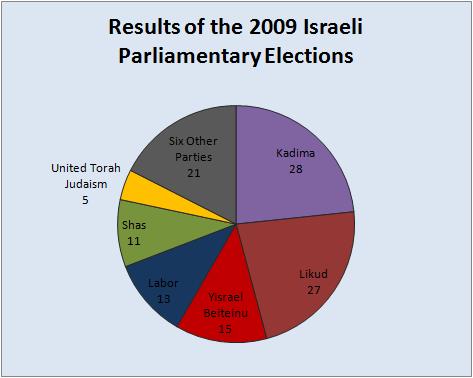
Elections for the Knesset, Israel's Parliament, were held on February 10. The elections were contentious. Both Tzipi Livni, of the centrist Kadima Party, and Benjamin Netanyahu, of the more conservative Likud Party, claimed victory on election night. It was not known which party won more seats until February 12. Kadima led by one:

However, the 28 seats won by Kadima was well short of the 61 needed for an outright parliamentary majority. A coalition was needed, and both Livni and Netanyahu could make arguments for the premiership. Livni's Kadima had won a plurality, but conservative parties won 65 seats, and Netanyahu was well-placed to form a coalition.

The ultra-right Yisrael Beiteinu placed third, and its head, Avigdor Lieberman, was proclaimed the kingmaker. Lieberman, however, is a controversial figure. He advocates a loyalty test for Arab Israelis and maintains that "the peace process is based on...false...assumptions." But achieving the premiership without his support would be either difficult or impossible.

Seeing the writing on the wall, Ehud Barak led the fourth-place, left-wing Labor Party into the Netanyahu coalition. Said Joe Klein, "The decision removes the last wisps of credibility that the Labor Party--the party of Ben Gurion, Dayan, Meir and Rabin--had in Israeli politics." Barak became defense minister; Lieberman, foreign minister.

Odds & Ends

Joe Klein says Netanyahu "is mostly blowing smoke" in his interview with Jeffrey Goldberg on Iran.

Lieberman is being investigated for "bribery, money laundering and breach of trust," upholding a longstanding tradition among Israeli politicians. After all, accusations of corruption led former PM Ehud Olmert to step down last September, which led Livni to take the reins of Kadima and the former coalition to fall apart, requiring the election in February.


Tuesday, April 7, 2009

Op-Ed: R E S P E C T

Is anybody else sick of Michelle Obama being judged day to day on her appearance, fashion, arms, and nothing more? What about the fact that she is an extremely intelligent, capable, successful, driven woman who has a lot more to contribute to the world aside from being somebody's wife? It's disgusting that already society has tried to define and contain her sphere of influence to the realm of women's fashion, as if to say that a woman cannot be beautiful, a mother, or an intellectual all at the same time. This is ridiculous. She's the First Lady, and the first black First Lady. Get over it and let her define herself and what she wants her role and influence to be.

Upon winning his Oscar for best leading actor in 1964 (the first black American to do so for a leading role), Sidney Poitier had this to say when confronted with all the media hype about what this win in particular meant to him: "I am artist, man, American, contemporary. I am an awful lot of things, so I wish you would pay me the respect due."

So please, America, pay Michelle Obama the respect she's due, too.

~J-Mad


*Not that by acknowledging a blog post as an op-ed piece is too different than what the blog format is all about in the first place, but I just thought I'd make it clear exactly what's going on here. This post is a little different than most other, headline-driven blog posts but I hope you enjoyed it nonetheless.