Showing posts with label Wolverine. Show all posts

Saturday, December 15, 2012

President, War Criminal

In an opinion piece published Tuesday, Joe Scarborough writes:
I suspect [history will be unkind] to those “progressives” horrified by George W. Bush’s anti-terror campaign but mute to the terror of the Obama administration’s savage drone wars. These sensitive souls, so repulsed by the waterboarding of three terrorists ten years ago, now celebrate their administration’s version of a war on terror that swapped out the targeted capture of terrorists with a drone program that all too often kills children, women, grandparents and scores of innocent young men.
Fair point. Barack Obama's record on civil liberties and executive privilege in the so-called war on terror is as bad as Bush's was. He has expanded the use of drones, which, yes, often kills innocent people and serves as a recruiting tool for terrorist groups, and has "embraced" a policy where all "military-age males" in a strike zone are presumed combatants, effectively rendering them guilty until proven innocent. He oversaw the passage of a National Defense Authorization Act (NDAA) that includes, in the words of the ACLU, "an extraordinary expansion and statutory bolstering of authority for the military to pick up and imprison without charge or trial civilians, including American citizens, anywhere in the world." He even sidestepped the War Powers Act, the most symbolic and perhaps the most unequivocal restraint on executive power, during NATO's intervention in Libya.

Granted, not all liberals have been quiet about Obama's use of drones or other worrisome aspects of his civil rights record. (Glenn Greenwald immediately comes to mind.) But we on the left have far too often been quiet, when loud political pressure is needed if we ever want these policies to change.

So mea culpa, Joe, you are absolutely correct. Until you write:
The release of the movie "Zero Dark Thirty" will surely lay waste to at least one of the left wing's lies: that the CIA's enhanced interrogation did nothing to gain actionable intelligence. “Zero” is generating angst amongst movie reviewers and essayists who were swept away by the film but left conflicted and uncomfortable specifically because this first draft of history accurately shows how the CIA's program played a major role in finding and killing Osama bin Laden.
So let me get this straight. Shame on liberals for being silent on Obama's unacceptable use of drones while loudly decrying Bush's apparently acceptable use of torture? I suppose you could make the moral case that drones are worse. But you cannot claim that torture is acceptable. You can't even claim that torture was effective in gathering intelligence (unless you want to believe a Hollywood movie over a report approved by the Senate Intelligence Committee).

Doing so makes you guilty of the same intellectual dishonesty you just accused us of.

Sunday, September 16, 2012

Who's Responsible for the Debt?

"If the Democrats inherited any deficit, it was the 2007 deficit, the last of the Republican budgets. That deficit was the lowest in the previous five years, and the fourth straight decline in deficit spending. After that, the Democrats in Congress took control of spending, and that includes Barack Obama, who voted for the wasteful budgets."
--One of those e-mails your Catholic grandfather forwards to you

Is any political trope more overused than the portrayal of Republicans as responsible fiscal conservatives and Democrats as "tax-and-spend" liberals? Well, let's look at how the deficit has changed over time and check whether this claim stands up. (Data taken from the FY2013 budget issued by the OMB.)

(Terminology note: The deficit is the discrepancy between the receipts or revenue the government takes in and the outlays or expenses the government sends out over the course of the (fiscal) year. This is not to be confused with the debt, which is the total amount owed by the government, i.e. the sum of all the deficits less any mythical surpluses over the entire history of the Union.)


Now we can see that the first claim is actually true. The FY2007 budget deficit was in fact the lowest in five years and the fourth-straight decline. It leaves out the fact that in FY2004--the year from which it was declining--Republicans controlled both houses of Congress and the White House. It also fails to mention that the CBO projected that $5.6 trillion would be removed from the national debt from 2002 to 2011, but instead $6.1 trillion was added to the debt due to the economic downturn & associated stimulus spending, the Bush tax cuts, the wars in Afghanistan and Iraq, and other reasons:


Looking at the first chart, we see that deficits more or less increase during the Reagan and Bush administrations and decrease during the Clinton administration to the point of running surpluses. During W. Bush, deficits again increase, peaking in FY2004 before coming down than coming up again for FY 2008 and 2009. Deficits have remained high during the Obama years. (I've started with FY1980 because, with few exceptions, previous deficits cannot be seen on this scale.)

But before we give Clinton too much credit, remember it's Congress that actually passes the budget, so let's see how the deficit changes with the political composition of Congress. We'll add the percentage of Republicans in both the House and the Senate to the chart. (Since Congress should pass the budget for the following fiscal year, the line graphs are offset by a year, e.g. the first points show the budget deficit for FY1980, but the percentage of Republicans in Congress in 1979.)


There does seem to be a trend during the W. Bush years, where more Republicans coincided with reduced deficits. But no such correlation holds over the entire 1980-2011 timeline. We can see this more easily by graphing the deficit against percentage of Republicans directly:


Now we know that having more Republicans doesn't lead (or even tend to lead) to reduced deficits. But maybe you're saying, "But just like it takes a long time to change the course of a large ship, it will take time for Republicans to reduce the deficit. The deficits for which a Republican Congress is supposedly responsible may be caused by policies enacted by Democrats in the previous Congress." Well, that may be so, but if Republicans were serious fiscal conservatives, then they would at least be reducing the deficit even if they can't generate instant surpluses. So instead of graphing the deficit, let's graph the change in the deficit (the first derivative in calculus terms). If anything, that is even more poorly correlated to the number of Republicans:


So what can we conclude? Both Democrats and Republicans are responsible for the size of the national debt. If you're serious about reducing the debt, you shouldn't vote Republican, you should work to repeal the 22nd Amendment and elect Clinton/Gore in 2016.

Saturday, May 26, 2012

Arab Spring Update: Yemen

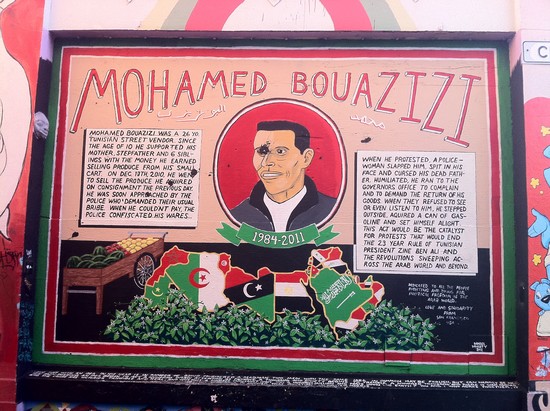
On December 17, 2010, a street vendor named Mohamed Bouazizi set himself on fire in protest. Four weeks later, Tunisia's Zine al-Abidine Ben Ali was gone. Protests spread to Egypt, Bahrain, Yemen, Libya, and Syria. Some successfully ousted their autocratic leaders, some were brutally repressed, and others are ongoing. In almost all cases, the final outcome is still up in the air. More than one year on, how have the countries of the Arab Spring fared?

Read Part 1 on Tunisia & Egypt and Part 2 on Libya & Bahrain.

Yemen

Change in rank in the Economist's Democracy Index 3

Protests began in late January 2011--after Ben Ali left Tunisia--as the Yemeni Parliament considered relaxing presidential term limits. Protesters feared this would have allowed President Ali Abdullah Saleh to remain in power or hand over the reins to his son Ahmed.

The situation started to turn violent as protesters and Saleh supporters clashed on February 17. At least five were killed. 45 were killed by security forces and Saleh supporters as 100,000 marched through the streets of the capital Sana'a on March 18.

Meanwhile, the Gulf Cooperation Council attempted to broker a deal between opposition leaders and Saleh. Saleh waffled between supporting the process and vowing not to sign the deal. In late May, a breakdown in the GCC process triggered battles between Saleh loyalists and fighters under Sadiq al-Ahmar, the head of the Hashid tribe (to which Saleh belongs) who sympathized with the protesters. A cease-fire was agreed upon five days later.

The truce was short-lived. Four days later, fresh clashes erupted between Ahmar supporters and regime forces and loyalists. Simultaneously, the regime attempted to clear protesters from the city of Taiz, the heart of the protests, killing 50. And clashes erupted between security forces and al-Qaeda militants in the southern city of Zinjibar.

On June 3, a rocket attack on the presidential compound injured Saleh. Official statements initially downplayed his injuries, but two days later, Saleh was in Saudi Arabia for medical treatment. Saleh's departure brought on celebrations and a drawdown in the fighting.

Attacks on protesters re-started on September 18. Over the next six days, at least 100 people were killed. On the 23rd, Saleh returned to Yemen.

In November, Saleh accepted the GCC deal. In exchange for stepping down, Saleh was to be granted immunity for any crimes committed as president. Yemen's Parliament officially granted Saleh--and his underlings--immunity in January. The deal has been criticized by human rights groups and Yemeni protesters. Saleh's vice president Abdrabuh Mansur Hadi was elected president in February with Saleh formally ceding power on February 27. Under the GCC deal, Hadi's government has two years to rewrite Yemen's constitution with fresh elections scheduled for 2014.

Though Saleh is officially out of power, Yemen's future is still uncertain. Separatists and extremists took advantage of the instability to consolidate their holds over parts of the countries. Houthis--Shiites in the predominantly Sunni Yemen--control the northwest. Southern separatists, wishing to undo the 1990 unification of North and South Yemen, control no territory but are capable of staging attacks against the government. They were responsible for attacks on polling stations during the February elections.

Most worrisome is al-Qaeda in the Arabian Peninsula and their affiliate Ansar al-Sharia. They are widespread in the south and east. U.S. drone attacks have increased; at least 35 have likely taken place over the last year. Most famously, AQAP propagandist (and U.S. citizen) Anwar al-Awlaki was killed on September 30. Fighting between Yemeni forces and al-Qaeda militants is ongoing; today 6 Yemeni soldiers and 27 militants were killed.

More than any other Arab Spring country, Yemen sits on a knife's edge. On one side lies continuing strife between the various tribes and factions. On the other side, if southern and Shiite separatists can be co-opted by the new government, if AQAP can be defeated ideologically (i.e. not just militarily), if protesters continue to fight peacefully for their rights, then maybe, just maybe, Saleh's ouster can lead to a more democratic Yemen.

Thursday, February 9, 2012

Arab Spring Update: Part 2

On December 17, 2010, a street vendor named Mohamed Bouazizi set himself on fire in protest. Four weeks later, Tunisia's Zine al-Abidine Ben Ali was gone. Protests spread to Egypt, Bahrain, Yemen, Libya, and Syria. Some successfully ousted their autocratic leaders, some were brutally repressed, and others are ongoing. In almost all cases, the final outcome is still up in the air. More than one year on, how have the countries of the Arab Spring fared?

Read Part 1 on Tunisia and Egypt here.

VOA Arrott - Bani Walid Seige Begins in Libya - 03

Libya

Change in rank in the Economist's Democracy Index: 33

With the help of NATO air support, Libyan rebels were able to overthrow Gaddafi's regime, taking Tripoli in August. After Gaddafi was killed in October, the National Transitional Council (NTC) declared Libya officially liberated.

The NTC is currently setting up elections for the National Assembly to be held in June. (The NTC has set up a government that will run the country in the interim.) The National Assembly is charged with writing a new constitution. Under the most recent election law, two-fifths of the seats will be filled by political parties with the remainder filled by independents. The final law dropped a 10% quota for women and reversed the decision to allow only independents to run. Electoral districts will be set up in the next few weeks.

The revolution has also unfortunately created a host of problems for the NTC and the region. Protesters in Benghazi have decried both the slow rate of progress and the inclusion of people like the NTC's vice president Abdel Hafiz Ghoga, who participated in the Gaddafi regime. (Ghoga has since resigned.) There have been clashes between the various rebel militias, between the rebel militias and the NTC army, and between Gaddafi loyalists and the NTC. Gaddafi loyalists even temporarily retook the town of Bani Walid two weeks ago. Proliferation of weapons, including portable, anti-aircraft weapons known as MANPADs, is a concern. And the influx of Tuareg rebels, fresh from fighting for Gaddafi, are causing problems in nearby Mali.

The lack of security and cohesion is disconcerting, but Libya is on the path of democratization. And according to Reuters, a recent poll says 80% of Libyans say their country is on the right track and 76% want a democratically elected government. Hopefully, the militias will view the National Assembly elected in June as legitimate and lay down their arms. But that will take both luck and pressure.

Protesters fests toward Pearl roundabout

Bahrain

Change in rank in the Economist's Democracy Index: 22

The Arab Spring came to the tiny island nation of Bahrain on February 14. On that day, protesters clashed with police, leaving over 20 injured and one dead. The opposition al-Wefaq party quit Parliament. Suppression continued until troops left the Pearl Roundabout (shown above), which had become the focal point of the rebellion.

Though Bahrain is predominantly Shia, the royal family is Sunni. And while protests drew both Sunnis and Shiites at first, the government fostered a "sectarian divide" in the words of a prominent Shiite sheik.

At the request of the Bahraini government, Saudi Arabia and the United Arab Emirates sent troops into the country on March 14 to restore order. Two days later, the protests were quashed and a curfew was established. There were reports of troops surrounding a hospital, preventing doctors and nurses from leaving and the wounded from entering. Opposition leaders were arrested. The government even tore down the iconic Pearl Monument.

Pearl Monument leveled

Since then, the Bahraini government offered half-hearted calls to dialogue, as smaller demonstrations continued in Shia neighborhoods outside of the capital of Manama.

The United States, while rightfully condemning the violence, has not called for regime change as it has in other Arab Spring nations. Bahrain is perceived to be a strong ally in the West's struggles with Iran, and Manama houses the U.S. Navy's Fifth Fleet. In the case of Bahrain, the U.S. has allowed its strong, short-term interests dictate its foreign policy.

Now, protesters are preparing to go back to the streets to mark the one-year anniversary of the uprising. They are amassing in an area outside of Manama set aside for opposition rallies dubbed "Freedom Square" to convey the same spirit of the Pearl Roundabout. In anticipation, the government has again called for a dialogue. In any case, the protests that perhaps seemed quashed a few months ago are far from over.

Read Part Three on Yemen.

Sunday, January 29, 2012

Arab Spring Update: Part 1

On December 17, 2010, a street vendor named Mohamed Bouazizi set himself on fire in protest. Four weeks later, Tunisia's Zine al-Abidine Ben Ali was gone. Protests spread to Egypt, Bahrain, Yemen, Libya, and Syria. Some successfully ousted their autocratic leaders, some were brutally repressed, and others are ongoing. In almost all cases, the final outcome is still up in the air. More than one year on, how have the countries of the Arab Spring fared?

Tunisia

Change in rank in the Economist's Democracy Index: 53

On October 23, 90% of registered Tunisian voters elected members of the Constituent Assembly, tasked with drafting a constitution and forming an interim government. The moderate, Islamic Ennahda ("Renaissance") Party won a plurality (89 out of 217) of seats and formed a coalition with the center-left Congress for the Republic (CPR) and Ettakatol Parties. On December 10, the Assembly adopted a provisional "mini-constitution" that establishes the framework for the interim government until a permanent constitution is adopted. Ennahda's Hamadi Jebali was chosen as the interim government's prime minister. Jebali appointed a new government and took office on December 24.

Though Ennahda is an Islamic party, there is little worry of it turning Tunisia into a fundamentalist state and rightly so. Ennahda's representatives have advocated a government based on the "Turkish model," i.e. a secular republic with a combination of Islamic and secular parties. Its platform called for gender pay equality. And it will be counterbalanced by liberal, secular parties both in its coalition and opposition.

The real issue is that the government is not moving fast enough to combat the economic issues that triggered the revolution in the first place. (Though Tunisians are highly educated, Tunisia's per-capita GDP is only $9,557.) According to activist Lina Ben Mhenni, the

people, now in power, have ignored the real problems of Tunisian citizens—the problems that drove people to the streets last year. Instead of addressing them, as they promised in their campaigns, they are trying to divert our attention to those issues of religion and identity. And, unable to keep their promises, they have started to use violence against the people who continue to demonstrate. In recent weeks, at least five people have set themselves on fire.

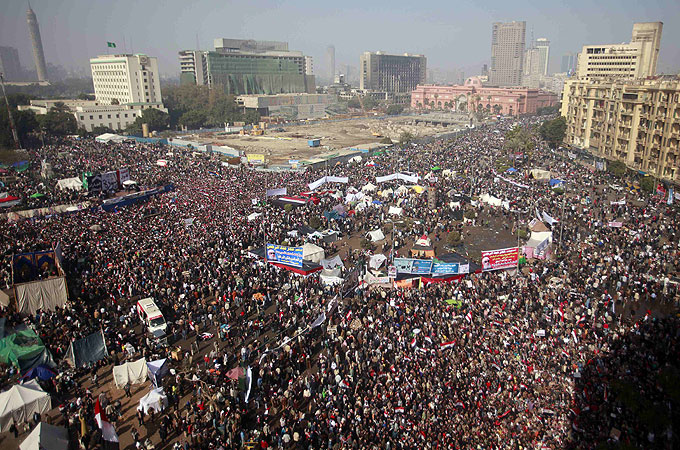
Protesters gathered in Tahrir Square four days ago with some commemorating the anniversary of the revolution and others calling for a renewal in revolutionary zeal.

Egypt

Change in rank in the Economist's Democracy Index: 23

The Arab Spring came to Egypt on January 25, as tens of thousands poured into Tahrir Square. Those numbers swelled, and Hosni Mubarak resigned on February 11, devolving power to the Supreme Council of the Armed Forces (SCAF) under Field Marshal Hussein Tantawi. Protests continued with demands ranging from speeding up reforms, postponing elections, and bringing Mubarak and others to trial. SCAF continued to use the emergency powers used by Mubarak, trying civilians in speedy military courts.

Elections for the People's Assembly--the Egyptian Parliament's lower house--were confusingly complex and held in waves from November through January. As in Tunisia, Islamists, in this case the Muslim Brotherhood's Freedom and Justice Party, won a plurality of seats due to their organization and their history of opposing the regime. The Assembly was sworn in on January 23, and the SCAF delegated legislative power to it. SCAF also announced a partial lifting of the state of emergency in place essentially since 1967. (In a statement, Tantawi said that emergency powers still applied in cases of "thuggery," which may render this statement hollow.) However, SCAF is still running the show in Cairo and has reserved 10 seats for itself in the Assembly.

Elections for the Shura Council (the upper house of Parliament) are ongoing and presidential elections are set to take place by June 30, after which SCAF will hand over power. Turnout for the Shura Council elections, unlike those for the Assembly, was low, as Egyptians are frustrated with the lack of progress. Both houses of Parliament will be responsible for creating an 100-member assembly tasked with drafting a constitution.

As it stands, there is a three-way contest for power between the armed forces, Islamists, and secular liberals. None of the sides are completely unified; indeed, there are over 100 political parties in Egypt today. There is a widespread opinion among the Egyptian people that the Muslim Brotherhood has made or will make a backroom deal with SCAF. More likely, in my opinion, is that the Brotherhood is trying not to alarm them in order to avoid an Algeria-style coup.

As in Tunisia, we should not worry that the Islamist FJP holds a plurality of seats. Though FJP's Saad al-Katatni is the Assembly's speaker, one of the deputy speakers comes from the Wafd Party (to Katatni's left) and the other comes from the Salafist Party (to his right). Like Tunisia's Ennahda, FJP has taken moderate stances in public and is rightly focusing on Egypt's economic problems. Egypt has been hit hard by inflation and a decline in tourism.

Tunisia and Egypt have arguably been the most successful in democratizing in the wake of the Arab Spring. Though the autocrats are gone, the revolution is not over, as the two nations wrestle with forming a new constitution, a new government, and new democratic institutions.

Read Part Two on Libya & Bahrain and Part Three on Yemen.

Saturday, January 21, 2012

Some Good News from South Asia

First, a major milestone in polio eradication has been reached in India; the country has gone a full year without a reported case of the disease. The Indian government worked closely with local religious leaders to spread the message and increase cultural acceptance of vaccination. The World Health Organization and Sabin Vaccine Institute are hopeful this strategy can be copied in central Asia and in west and central Africa, where polio is still endemic.

But perhaps the even bigger story is the continuing democratic reforms in Burma. The reforms began after elections in 2010. Though there were widespread charges of fraud and the election was boycotted by Aung San Suu Kyi's National League for Democracy (NLD), Burma's military junta ceded some of its power to the new Parliament.

Suu Kyi was freed from house arrest in November 2010 and is running for Parliament in upcoming elections. Laws censoring the press have been relaxed and websites like Youtube have been unblocked. Construction of the controversial Myitsone Dam in northern Burma, which would endanger the Kachin people's cultural identity and (seeing as it's located near a major fault line) their lives, has been suspended. The government has signed a cease-fire with Karen insurgents in the east. Political prisoners, including student protesters from 1988 and Buddhist monks from 2007's "saffron revolution," have been released in two batches, first in September 2011 and then again this month.

The U.S. has been engaging with the Burmese government. Secretary of State Hillary Clinton visited the country after the first batch of political prisoners was released. After the second, the U.S. announced that it would exchange ambassadors with Burma for the first time since 1990. The Obama Administration should be lauded for how they have handled the situation, though reforms have resulted more from conditions on the ground than diplomatic engagement.

So why has the Burmese government started these reforms? Partly there is a desire to ease Western sanctions, which have restricted travel of prominent members of the regime, frozen their assets, and limited foreign investment in the country. More importantly, argues Marie Lall of the University of London, is the government's desire to chair the Association of Southeast Asian Nations (ASEAN) in 2014 and for greater economic integration with the rest of the ASEAN community.

Whatever the reason, let's hope that Burma continues down the path of democratic reform.

Monday, June 27, 2011

Could Athenian-Style Democracy Work Today?

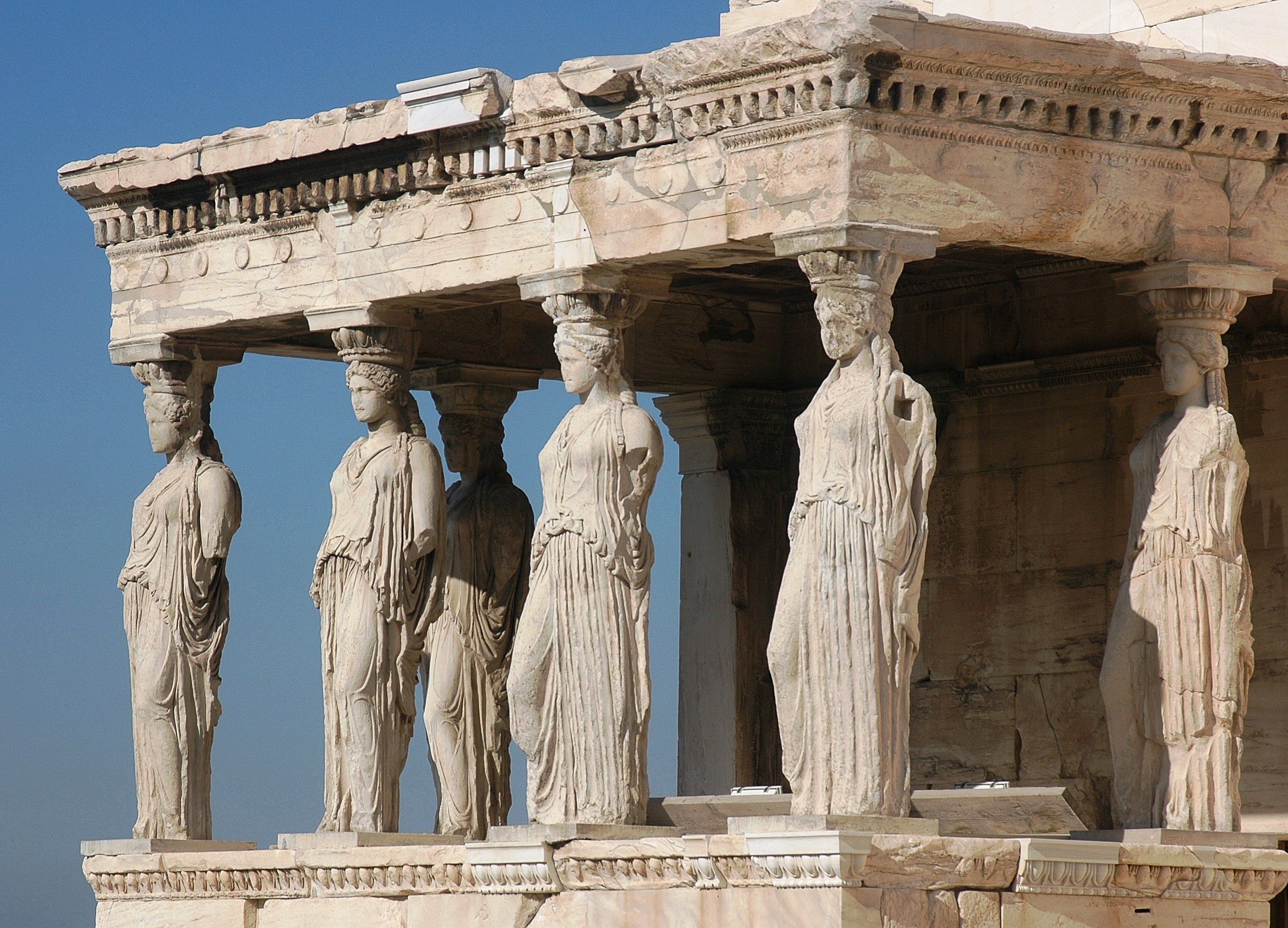
Used under Creative Commons License from Wikipedia user Harrieta171

The government of the United States is technically not a democracy; it is a republic. We elect people to represent us, but we otherwise have no direct role in government.

The democracy of ancient Athens, however, was a true democracy. The assembly (ekklesia) basically consisted of all the adult male citizens who bothered to show up that day. The assembly was the Athenian legislature, responsible for enacting laws, declaring war, and bestowing citizenship. The council (boule) was like the executive branch; they carried out the laws passed by the assembly, but also decided what proposals the assembly would deliberate. The members of the council were chosen by lottery. Trials were all decided by juries of one's peers, again selected by lottery.

The setup worked fine for the ancient city-state, but wasn't practicable when the U.S. was founded. A Georgia farmer couldn't be expected to ride north for the capital every time the American Assembly met. Even today, flying or driving to Washington would be onerous for the average citizen. But now, we don't have to be there physically when we could be there virtually.

So how do we adapt Athenian democracy to fit modern times? The complex bureaucracy necessary for modern governing poses an obstacle. These positions require a technical expertise that we cannot expect every citizen to have. So let's retain the executive branch essentially as it is.

But let's completely explode the legislative branch. Every morning, a daily boule of 100 people will be selected randomly. (Or whatever number and frequency is most sensible.) Each person, if they wish, will be able to propose one law or proposition. They can come up with their own or use a suggestion from citizens who have not yet been chosen for the boule. The proposal can be as simple or as complex as the person wants.

Over the course of the day, every adult citizen can debate and vote on the boule's proposals. Comments can be shown with the proposal and top-rated ones can be shown first like on YouTube. By the evening, the votes will be counted and proposals with a simple majority pass.

It is then up to the executive branch to turn the laypersons' proposals into reality. If people disagree with the actions of those in the executive branch, then a member of the boule could call for a vote of no-confidence. If that official does not retain majority support, they will hold that office as a caretaker for a month while others campaign for it. All Cabinet-level positions will be decided this way.

An independent judiciary will be necessary to check the "tyranny of the majority," i.e. to prevent our assembly from depriving rights from a minority. For this reason, judges and justices cannot be removed by no-confidence votes. Whether they will be elected by the assembly or appointed by the president and confirmed by the assembly...well, I'm not sure which is better.

And what of that de Tocqueville quote? The American Republic will endure until the day Congress discovers that it can bribe the public with the public's money. Our system cuts out the middleman. If given more direct power over our government, will we use it responsibly?

Well, how responsibly is it used now? Senate Democrats don't want to propose a budget because "The Ryan budget is being so good for Democrats. Why mess that up?" Republicans are playing with fire on the debt ceiling due to their unwillingness to even hear the words 'tax increase.' Regardless of whether this is temporary posturing or permanent intransigence, both Congressional Democrats and Republicans are more interested in playing politics than, you know, actually governing.

Plus, it will be harder for moneyed interests to buy off members of Congress when essentially every American is a member of Congress. Granted, they can still use the mass media to sway the public, but that strikes me as more difficult and maybe even fairer.

But maybe you still have your doubts. So let's get together 10,000 people or so, a good cross-section of America, and do a practice run. After a year, compare the course our fake assembly has taken the country with that of Congress. And then we will have our answer.

Sunday, June 19, 2011

Death in the Amazon

A few months ago Obede Loyla Souza, an activist and farmer living in the Brazilian state of Para, argued with loggers who were illegally felling trees in the Amazon. He began receiving death threats. Eight days ago, his body was found with a shotgun blast to the head.

Souza is the sixth person over the last month to be killed in feuds over Amazonian land. The murders apparently began with husband and wife Joao Claudio Ribeiro da Silva and Maria do Espirito Santo, conservationists who worked at a nature reserve. They also had received death threats from loggers and cattle ranchers.

The killings come as Brazil's Congress considers a bill that would reform the country's Forest Code. (The bill has already passed the Chamber of Deputies, the Congress's lower house.) A key element of the bill is a provision granting amnesty for farmers who own less than 400 hectares of land who had illegally cut down trees. Because of the sense of impunity fostered by this provision, the rate of deforestation in March and April was six times faster than last year.

Sunday, June 12, 2011

"CO2 is plant food"

"Plants, as far as I know, are still, still bending toward the light, and if we dance until the heart explodes, it'll make this place ignite."

~MGMT, "Flash Delirium"

"CO2 is not a pollutant; it is green plant food."

~Pierre R. Latour

"The current focus on carbon dioxide has nearly run its course, as it has been clearly shown that it is not harmful. In fact, the slight increase in its tiny concentration will assist agriculture and help to feed the starving people of the world."

~Edward B. Boyle, Jr.

Alas, the world is far more complicated. While it's true that a higher concentration of CO2 would, in a vacuum, improve plant growth, the overall effect on agricultural yields requires a bit of work to tease out.

The changes in climate wrought by more carbon dioxide will improve yields in some areas while hurting yields in others. A recent study published in Science examined the effects of changes in CO2 concentration, temperature, and precipitation on the yields of the four stapliest of staple crops--corn, wheat, rice, and soy--from 1980 to 2008. They estimated that globally, climate change improved rice and soy yields by 2.9% and 1.3%, while corn and wheat yields declined by 3.8% and 2.5%, respectively. These changes caused global food prices to increase by 6.4%.

Another study concluded that by 2030, 370 million people, mostly those who are already poor and vulnerable, will experience reduced crop yields due to climate change.

Furthermore, higher levels of CO2 will affect different plants differently. The yellow starthistle, "the worst weed of the West", would grow 600% larger in elevated concentrations of CO2 compared to only 15% for native plants.

So yes, there is a seed of truth in the claim that carbon dioxide is yummy plant food. But the effect of more CO2 on agricultural yields is overall a negative one.

Wednesday, May 4, 2011

It's a Gas, Gas, Gas

Gas prices are averaging $3.96 a gallon nationally and a record-breaking $4.26 a gallon here in Michigan. Some families spend over 13% of their income on fuel. And yet oil companies receive $4 billion annually in subsidies from the federal government. Exxon Mobil, Chevron, Valero Energy, ConocoPhillips, and even BP have all received tax breaks from the IRS.

This is ridiculous. (Even more ridiculous is that we knew this was a problem during the 1970s oil embargo and yet we have spent the last 3 to 4 decades DOING NOTHING.) And gas is going to get even more expensive as demand increases, especially from the burgeoning economies of China, India, etc., and as remaining oil supplies dwindle and become harder both to access and to refine.

So here's what we do: End oil subsidies and put that money into R&D and subsidizing clean energy. The sooner our economy is based on renewable energy instead of being shackled to dirty, foreign oil, the better.

Monday, May 2, 2011

Two Thoughts on the Death of bin Laden

1. I used to wonder how bin Laden could send young men off to their deaths and not be expected to make a similar commitment himself. What heroism was there in running to save his own skin after we invaded Afghanistan? But I realized that al-Qaeda leadership could always have argued that somebody needed to be in charge. Maybe they could've even portrayed hiding in the mountains and caves of Afghanistan/Pakistan as some heroic sacrifice.

Now we know that that would've been a lie. Osama wasn't hiding in caves, but in an expensive compound in Pakistan. He didn't die a martyr; he used his wife as a human shield, trying desperately to prolong his life that much further. Bin Laden wasn't a leader; he was a hypocrite and a coward.

2. Some are jumping on the fact that the tip originated from torturing a Gitmo detainee to argue for resuscitating enhanced interrogation and keeping Guantanamo open. But that assumes we couldn't have gleaned this information otherwise and ignores the other effects of torture. What's more, as I've said before, effectiveness is irrelevant; torture is immoral and illegal. Period.

Monday, December 27, 2010

Jon Stewart: Our Hero

Tip of the Hat to Jon Stewart for devoting all of his last episode before The Daily Show's holiday break to the 9/11 responders bill--you can see the full episode here--saving the legislation almost single-handed. I'm not the only one singing his praises. First, the White House commended Stewart for his role in reviving the bill. Now, even the New York Times is making the comparison to Edward R. Murrow. (h/t)

And a related Wag of my Finger to the mainstream news who apparently forgot about the bill, along with their roles as journalists.

Wednesday, December 22, 2010

Values Voting

The Senate finally ratified the new START Treaty, 71-26, more than eight months after it was signed by Obama and Medvedev. And they finally passed a nearly two-year-old bill providing compensation to 9/11 responders and clean-up crews, and even then, only after reducing both how much and how long funding would be available. But, you know national security and caring for the heroes of September 11 are not as important as tax cuts for the rich.

Welcome to the new Republican Party.

Tuesday, September 7, 2010

Why Building the Mosque is Important

"Try to learn instead of burn, hear what I say." ~Jimi Hendrix

The "war on terror" has been compared to the Cold War, and while I think historical comparisons can obscure important nuances, the comparison makes sense in at least two ways. First, invading a country and imposing a government on it is going to be seen as imperialist, even if it's well-intentioned. And second, both wars are fundamentally wars of ideas.

Al-Qaeda's idea is obvious: Western liberal democracy is incompatible with Islam and must be fought. Looking at our history, our idea is also obvious: Islam and liberal democracy are compatible.

There are those who would cede the first point to al-Qaeda, who believe that our idea should be, 'Yes, democracy and Islam are incompatible, but it is Islam that must be fought.' But a war of ideas can not be won by force; it can only be won by persuasion. And the more we act like we are at war with Islam, the more Muslims will be at war with us.

A war on Islam is not a war that we can win, nor should it be a war that we want to fight. No, we win the war on terror by encouraging moderate Muslims to say and say it loudly, "Al-Qaeda, you are wrong. We do not need to fight democracy but to foster it. We reject your ideas, and you are not the true face of Islam." But if we continue to lump in our moderate friends with our extremist enemies, we undermine our allies and we lose the war.

Thursday, September 2, 2010

The Troy Davis Saga

Nineteen years ago, Troy Davis was convicted of murdering an off-duty cop and sentenced to death. Last week, after Davis' latest appeal, a federal judge ruled that "the evidence presented by Davis' attorneys at a June hearing wasn't nearly strong enough to prove he's innocent." As reported before, the case is especially egregious because:

There was no physical evidence; the weapon was never recovered. The case rested entirely on eyewitness accounts. All but two of the witnesses have since recanted their testimony, some of whom say they were coerced by police. And one of the two witnesses who have not changed their story is the best alternate suspect.

Whether or not Troy Davis is innocent, there are at least serious doubts of his guilt. And the fact that the state of Georgia could be executing an innocent man is more than enough of a reason to severely restrict the application of the death penalty, if not abolish it altogether.

Sunday, July 18, 2010

France's Burka Ban

A few days ago, in a Europe fearful of "Islamization," the lower house of the French Parliament voted to ban burkas and most other face-coverings. The ban is plainly about protecting French identity from the apparently un-French burka. A few might say it is to protect women from oppression -- and indeed, any man found to have forced a woman to cover her face will himself face up to a year in jail and a 30,000-euro fine -- but even women who freely choose the burka will be fined.

No, the ban is about French unease with the Islamic covering. I expect most Americans would agree with me; the libertarian argument that people should be allowed to wear what they want would hopefully carry the day. And yet the French debate on the burka reminds me of the American debate on gay marriage. Both are portrayed as threatening, but the bans have less to do with real threats to French society or heterosexual marriage than they do with French or heterosexual insecurity. And they should deal with their insecurity in a way that does not oppress a minority.

Saturday, June 19, 2010

Dear Congressman Hoekstra

Your recent "Perspective" is an interesting example of empty political posturing. You express your opposition to a cap-and-trade program that would regulate CO2 emissions, which you call a "job-killing National Energy Tax." Yet you also want to promote renewable energy to reduce both our dependence on foreign oil and pollution to the environment.

I agree that we should encourage clean energy, but how exactly do you propose to do this? We could discourage carbon-emitting energy sources by taxing them or instituting a cap-and-trade program, but you clearly believe that would kill jobs. Alternatively, we could subsidize clean energy, but we would have to institute a "job-killing" tax to pay for it to avoid being irresponsible and increasing our national debt. Or we could mandate that utilities must produce a certain proportion of their electricity from renewable energy in a one-size-fits-all regulation. But that would ignore regional and other differences and would not allow companies to behave as rational, economic actors.

As your constituent, please tell me how you plan to promote clean, renewable energy. You don't get to have your cake and eat it too just because it's an election year.

Sincerely,

Wolverine

Note: This is not the first example of Hoekstra's disingenuousness.

Tuesday, May 25, 2010

Oh, the Hypocrisy!

"Everyone is entitled to his own opinion, but not his own facts."

~Daniel Patrick Moynihan

In an article bemoaning conservatives' apparent disconnect from reality, Paul Waldman writes these two paragraphs and puts them next to each other, apparently unironically:

Ascribing the most nefarious of motives to our political opponents is standard fare, of course. But basing your political arguments not on what those opponents have done or have proposed to do but on what they "would" do, frees you from the need to keep a hold on even the slightest tether to reality. Who needs evidence of the other side's evil, when you can just imagine what lies in their hearts?

Imagination also has its psychic rewards. Take the Tea Partiers. The vast majority would probably say that Barack Obama, that vile socialist, has raised their taxes. The truth, however, is that Obama cut taxes for 98 percent of working families with the stimulus bill. You could argue that those tax cuts weren't a good idea, but you ought not to be able to argue that they didn't happen.

So to sum up: Paragraph 1: Basing your arguments on what your opponents would do frees you from reality. Paragraph 2: Tea Partiers would say that Obama raised their taxes, but it's not true.

Waldman's only justification of this is Tea Party Nation leader Judson Phillips refusing to admit that most Americans' taxes decreased under Barack Obama. Does Waldman bother to mention a New York Times poll where a majority (52% to 42%) of Tea Partiers say that the amount they pay in income taxes is fair? No, there's no sign that Waldman even looked at it.

I am sympathetic to the argument that conservatives' reliance on straw men comes at the expense of facts. But that doesn't mean that liberals should emulate it.

Monday, May 24, 2010

The American Power Act

Much has been said about the American Power Act, introduced to the Senate on May 12. It would incentivize more offshore drilling and nuclear power. It would limit the EPA's capacity to regulate greenhouse gases under the Clean Air Act. And it does not nearly reduce greenhouse gas emissions enough.

Some of these complaints are misleading: For instance, the American Power Act only limits the EPA's ability to regulate under the Clean Air Act because it establishes a cap-and-trade system for large carbon emitters. EPA would deal with these emitters under the American Power Act, while still reserving the ability to regulate other emissions, like automotive emissions, under the Clean Air Act.

And in spite of these complaints, the American Power Act deserves our support. It finally sends a signal that the United States will regulate greenhouse-gas emissions. Such a signal is needed for entrepreneurs to invest in researching and implementing green energy. Indeed, it is precisely what they are waiting for.

And yes, it does not reduce greenhouse-gas emissions enough. But it is much easier to establish the cap-and-trade framework and adjust later on. And as Joe Romm reminds us, this is exactly what happened with the Montreal Protocol and the Clean Air Act(s).

Yes, the bill is flawed and we should lobby the Senate to improve it. But those flaws should not prevent us from taking the first real step to fight global warming and passing this bill.

Saturday, May 8, 2010

This Should Be a No-Brainer

The Obama administration is considering joining the Ottawa Treaty, which bans the use of land mines. Which are of no use in the counterinsurgencies we're fighting in Afghanistan and Iraq. The only place they would be useful is in the ironically-named demilitarized zone between North and South Korea. But control over those mines has been transferred to South Korea. Not to mention that "technological advances have enabled the Pentagon to create explosives that function like mines but are detonated remotely, making them permissible under the treaty."

There is even enough support in the Senate for ratification. Sixty-eight senators have signed on to a letter calling on Obama to join the ban. (67 are needed for ratification.) There is no reason not to do this.