Sunday, September 20, 2009

Bad Arguments and No Arguments

Ten days ago in the Michigan Daily, Chris Koslowski politicized the death of Ted Kennedy. But not in a way you might think:

Obama has said again and again that a major factor behind the failure of the current health care system is the execution of needless or futile medical procedures. Among these procedures, Obama specifically mentioned surgeries for terminally ill patients. During a primetime ABC broadcast from the White House this summer, he said, “Maybe you’re better off not having the surgery, but taking the painkiller.”...

Obama, and everyone who is in favor of public health insurance, needs to ask themselves... Would Kennedy, if he were a private citizen of average income under Obama’s public plan, have been able to pursue these life-extending procedures, given his age and condition?

Koslowski makes the point of all opponents of reform: "Obamacare is bad." But that doesn't fully address the relevant point: whether health-care reform will be better than what we have now. The fact that Koslowski doesn't ask whether his hypothetical, average-income Ted Kennedy would have been covered under a current, private plan (Answer: Probably not) shows that he hasn't done this cost-benefit analysis.

The problem is Democrats and proponents of health-care reform have not been making this argument effectively. Yes, whatever plan that comes out of Congress probably won't cover everything. But it will be better than what we have now.

Monday, September 7, 2009

Putting America to Work

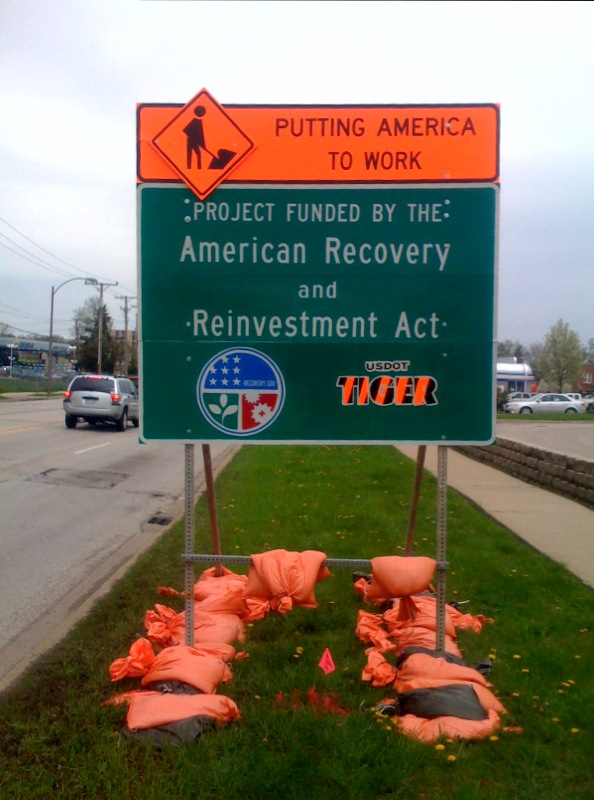
From the 127-96 junction near Lansing to I-94 around Battle Creek to some stretch of I-75 in Ohio, road signs are popping up announcing construction season. But one sign in particular stands out.

These signs are politically brilliant. Just as people are starting to wonder where the stimulus money went, these signs pop up saying, "You can thank Barack Obama for these (soon to be) smooth roads."

So Happy Labor Day everybody. Hopefully, we'll all be employed again soon.

Friday, September 4, 2009

Broken Promises

"Please note that because these funds are not yet available and funding is uncertain, you should make arrangements to cover the amount of your Michigan Promise Scholarship with other resources."

~University of Michigan Office of Financial Aid, in an email to students

On June 23, the Michigan State Senate, facing a $1.7-billion deficit, voted to axe the Michigan Promise Scholarship, which provides funds for over 96,000 students across the state, including (for the sake of transparency) me. (The scholarship may be reinstated before the state budget is due on October 1.)

I understand that the state has to either cut something or raise taxes, but I feel I have to respond to this guy:

These kids will just have to work their way through school like the earlier generations did. The days of the handouts are over.

Unfortunately, that's just not economically feasible. Upper-level engineering tuition at U-M is $15,926. How anyone could possibly be expected to pay for that plus rent, utilities, groceries, books, etc. without scholarships while taking on a full course load is beyond me. In my case, the $3300 that would have come from the Promise and the Michigan Competitive (also of uncertain future) is the difference between having expenses covered and taking a serious hit to my savings account. (The no-handouts crowd should note that I'm already assuming I'll work next summer and during the school year.)

Furthermore, financing college education makes good economic sense. College graduates are less likely to be unemployed, poor, or incarcerated, less likely to smoke, and more likely to volunteer, vote, and give blood. But because individuals don't consider the benefits to society when deciding whether to go to college, too few enroll. Government intervention in the college market makes sense, especially in Michigan, the Water Winter 15%-Unemployment Wonderland.

Yes, the state will have to do something unpleasant, but this unpleasantness hurts students now and will hurt Michigan in the future.

Sunday, August 16, 2009

Afghan Women Update

Back in April, 300 women took to the streets of Kabul to protest a new law that would require Shiite women to have sex with their husbands and restrict their ability to get an education and even leave the house. The bill had passed Parliament and had been signed by Afghan President Hamid Karzai, but had not been published in the official gazette and was not yet law.

Now, the amended bill has been published. The amendments have hardly improved it. The bill, according to the BBC, "allows a man to withhold food from his wife if she refuses his sexual demands; a woman must get her husband's permission to work; and fathers and grandfathers are given exclusive custody of children." Karzai supported the bill likely in order to win votes from the Shiite community in the impending August 20 election.

The bill is sadly just one reminder of how far away decent treatment of Afghani women still is.

Saturday, August 15, 2009

Even Smart People Can Be Stupid

So I was reading The Bent, a quarterly publication by Tau Beta Pi, like a good enginerd, and one of the letters made my blood boil. It was written by Pierre R. Latour, who worked on the Apollo Program, and was part of the back-and-forth on global warming that's been raging for nine issues. Let's go through some of it:

1. Earth's temperature is a property of a distributed, dynamic chemical process control system. A thermostat reduces variations about a desired set point by feedback manipulation of significant energy flows.

This letter was written by an engineer to an audience of engineers, and even though I'm an engineer, I don't know what he just said. Maybe it's because I'm the wrong type of engineer (civil, not chemical like Mr. Latour) or maybe it's because I'm still a lowly undergrad. Either way, this paragraph doesn't actually say anything, and merely serves to make Mr. Latour sound smart.

2. Earth's average atmospheric temperature is unmeasurable...

Okay, it's true that we couldn't take the temperature of every single point on Earth and calculate the exact average. But we could sample a bunch of points on Earth and get a good guess and a margin of error. If the sample average changes beyond the margin of error, then we can be confident that the actual average is changing. Apparently Mr. Latour never took a statistics class.

No professional control engineer would accept responsibility for engineering Earth's thermostat. His first duty is to do no harm...

First, I don't think anyone wants to engineer a global thermostat. A thermostat, as Mr. Latour was probably trying to say in his first, jargon-filled paragraph, responds to the current temperature. I want my apartment to be between 68o and 78o. If it's hotter than that, turn on the AC; colder, the heat. That's a thermostat. The response to global warming is closer to, "Hey, the heat's been on for a while. Let's turn it down before it's 90o in here."

Second, you would think that "first do no harm" would be an argument to stop pumping CO2 into the atmosphere. Under this guise, if you don't know what it will do, you shouldn't do it. The Earth seemed fine before we started pumping it out.

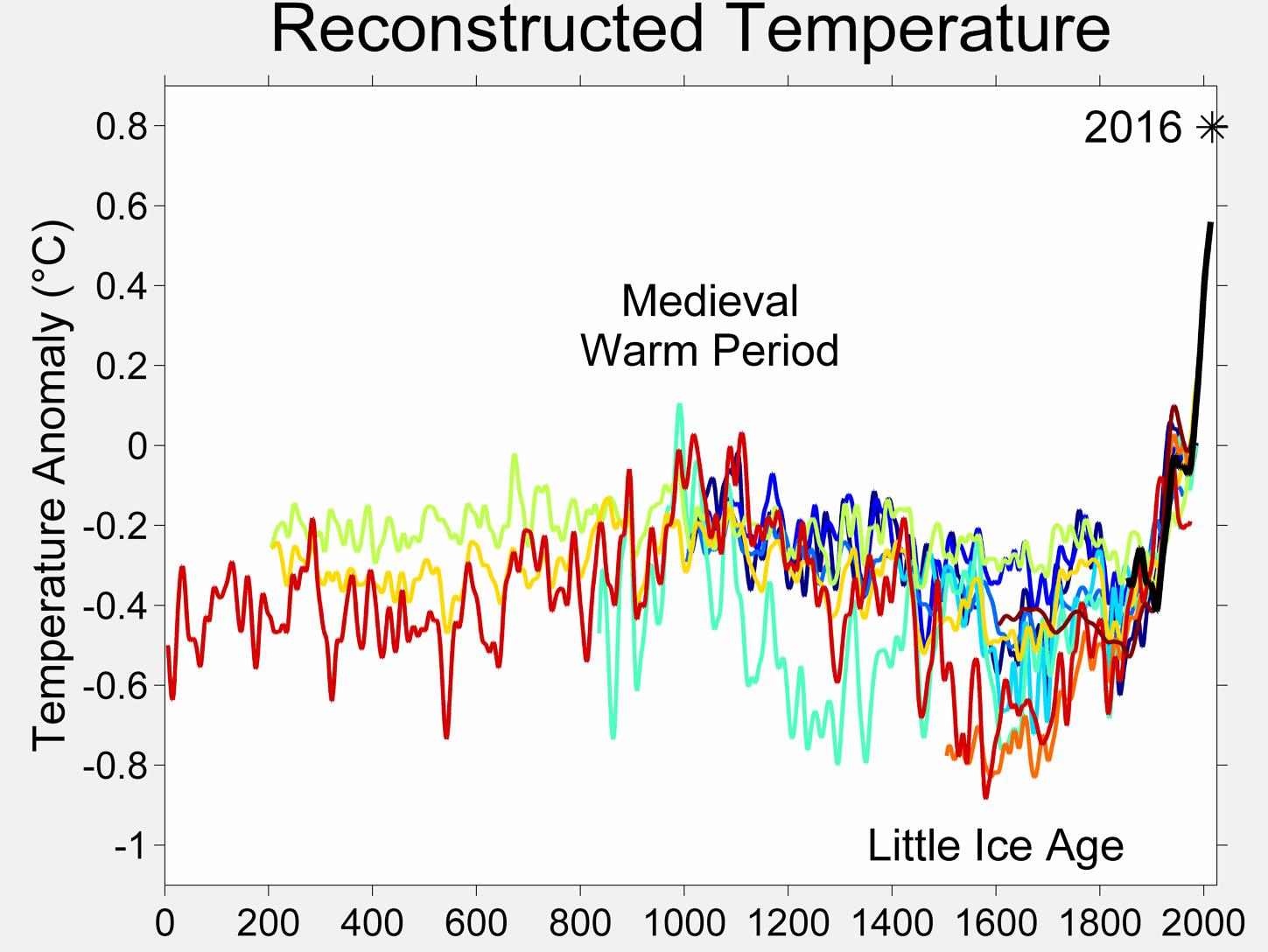
3. While Earth's temperature has been warming slowly for 25,000 years and drifted up 0.6oC from 1975-98, (0.026oC/year), [sic] it stopped increasing since 1998...

Hmm, the "unmeasurable" global average temperature increased 0.026oC/year between 1975 and 1998? Interesting. And while the Earth's temperature does fluctuate naturally, there has been a sharp increase that started, incidentally, about the same time as the Industrial Revolution:

4. The melt rate of ice is proportional to atmospheric temperature, not the derivative of temperature [i.e. how fast the temperature is changing, for the calculus-deprived]. Ice melts because its surface is warm, not warming. A glacier shrinks because it is warm; [sic] even if it is cooling.

Wow. And if its surface keeps warming, it will be warm enough to melt.

5. The prime mover of Earth's energy balance and temperature is the sun. Atmospheric CO2 lags ocean and atmospheric temperature because its solubility decreases with temperature, just like champagne bubbles do. So temperature changes cause CO2 changes, not the other way around.

You know where else the sun acts as the prime mover of temperature? A greenhouse. But a greenhouse wouldn't be as warm without the glass. A greenhouse is, of course, in no way analogous to the effect to which it lends its name.

And temperature changes causing CO2 changes doesn't automatically discount "the other way around." You would think a systems engineer would have heard of a feedback loop.

6. CO2 is not a pollutant; it is green plant food. Its greenhouse-gas effect is irrelevant and benign. H2O vapor effects are 1,000 times greater. The greenhouse-gas effect is essential for life...

Most of what Mr. Latour says here is true; he just fails to understand the concept "too much of a good thing." Carbon dioxide and the greenhouse effect are both essential for life. (Without the greenhouse effect, the Earth would be about -17oC.) Water is essential for Mr. Latour's life, but I doubt he wants me to pump 27 trillion kg of it into his house every year.

And it's true that the contribution of water vapor to global warming is higher than that of carbon dioxide, but the effect of adding more of it into the atmosphere is not as dramatic as that of CO2. First, more water vapor means more clouds, which increase the Earth's albedo, reflecting sunlight back into space and reducing the amount of heat that reaches the earth in the first place. Second, increasing water vapor concentrations won't close the atmospheric window. (The greenhouse effect happens when molecules in the atmosphere absorb electromagnetic radiation, trapping it in Earth's atmosphere. But molecules absorb electromagnetic radiation only at particular wavelengths. Water, for instance, absorbs wavelengths around six microns, and practically none of that escapes the Earth's atmosphere. There is little in the atmosphere that absorbs in the 8-12 micron range. CO2 does.)

8. By March 16, 2009, more than 700 international scientists have testified to the Senate's environment and public works committee,...debunking any claims of scientific consensus for anthropogenic global warming (AGW)...

While it's true that belief in AGW is not universal among scientists, 84% of scientists "think that earth is getting warmer because of human activity."

No benefit-cost financial analysis...has been provided...

Really? What's this?

11. It has been clear since 2006 that AGW is a scheme to tax people with CO2 caps...

Really? Global warming is an elaborate hoax to provide political cover for taxing businesses? Since when have politicians put this much work into anything?

Besides, if they wanted to tax business, there are better things on which to base the taxation, like revenues or profits. I'd hope that the Democrats aren't such Milquetoasts that they have to invent an elaborate hoax and convince millions of people of its veracity before they are comfortable enough to enact a simple tax.

After the end of his letter, it says that Mr. Latour graduated from college in 1962, which means he's around 70 now. If he's wrong, he won't be the one who has to live with the consequences.
Wednesday, August 12, 2009

One More Angle

With the recent commotion surrounding the bill for health care reform (and the fact that the bill is 1000+ pages), there has been a great deal of misunderstanding of the issue from all sides. Fortunately, Jonathan Cohn broke it down very accurately and comprehensibly on The Colbert Report last night. Check it out.

The Colbert ReportMon - Thurs 11:30pm / 10:30c
Jonathan Cohn
www.colbertnation.com
Colbert Report Full EpisodesPolitical HumorMeryl Streep

"The Daily Show" Peeks Behind the Veil

While this post may be a little late as far as airtime, the issues are still apt. In June, "The Daily Show" sent correspondent Jason Jones to Iran to cover the Iranian presidential elections. Due to unanticipated events, the show (and Jones) got more than what they bargained for. The four links below are the four segments The Daily Show produced. Like other pieces the show has aired, the subject is covered in detail, depth, and serious unique to Stewart's brand of humor. And as usual, the perspective is unique and vastly more intelligent than any other programming. Enjoy.

Behind the Veil: Minarets of Menace (aired 17 June 2009)
Behind the Veil: Persians of Interest (aired 22 June 2009)
Behind the Veil: Ayatollah You So (aired 23 June 2009)
Behind the Veil: The Kids are Allah Right (aired 24 June 2009)

The video below is the music video for "Ye Mosht Sarbaz" by Hichkas. English subtitles are provided.


Below is an interview with Reza Aslan, scholar and author on Islam and Iran.
The Daily Show With Jon StewartMon - Thurs 11p / 10c
Reza Aslan
www.thedailyshow.com
Daily Show
Full Episodes
Political HumorSpinal Tap Performance