Showing posts with label Egypt. Show all posts

Sunday, January 29, 2012

Arab Spring Update: Part 1

On December 17, 2010, a street vendor named Mohamed Bouazizi set himself on fire in protest. Four weeks later, Tunisia's Zine al-Abidine Ben Ali was gone. Protests spread to Egypt, Bahrain, Yemen, Libya, and Syria. Some successfully ousted their autocratic leaders, some were brutally repressed, and others are ongoing. In almost all cases, the final outcome is still up in the air. More than one year on, how have the countries of the Arab Spring fared?
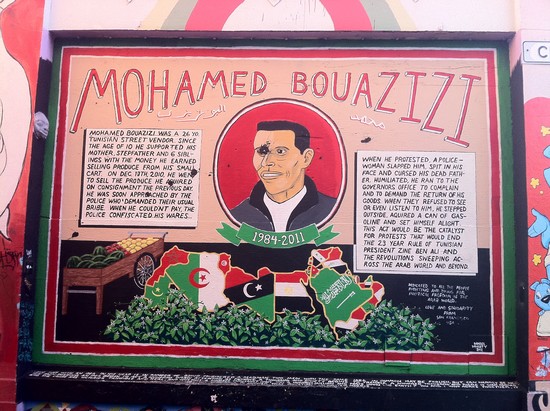
Tunisia

Change in rank in the Economist's Democracy Index: 53

On October 23, 90% of registered Tunisian voters elected members of the Constituent Assembly, tasked with drafting a constitution and forming an interim government. The moderate, Islamic Ennahda ("Renaissance") Party won a plurality (89 out of 217) of seats and formed a coalition with the center-left Congress for the Republic (CPR) and Ettakatol Parties. On December 10, the Assembly adopted a provisional "mini-constitution" that establishes the framework for the interim government until a permanent constitution is adopted. Ennahda's Hamadi Jebali was chosen as the interim government's prime minister. Jebali appointed a new government and took office on December 24.

Though Ennahda is an Islamic party, there is little worry of it turning Tunisia into a fundamentalist state and rightly so. Ennahda's representatives have advocated a government based on the "Turkish model," i.e. a secular republic with a combination of Islamic and secular parties. Its platform called for gender pay equality. And it will be counterbalanced by liberal, secular parties both in its coalition and opposition.

The real issue is that the government is not moving fast enough to combat the economic issues that triggered the revolution in the first place. (Though Tunisians are highly educated, Tunisia's per-capita GDP is only $9,557.) According to activist Lina Ben Mhenni, the

people, now in power, have ignored the real problems of Tunisian citizens—the problems that drove people to the streets last year. Instead of addressing them, as they promised in their campaigns, they are trying to divert our attention to those issues of religion and identity. And, unable to keep their promises, they have started to use violence against the people who continue to demonstrate. In recent weeks, at least five people have set themselves on fire.
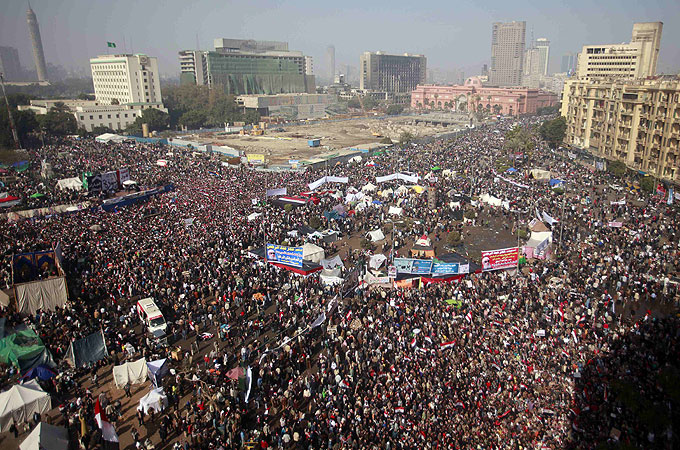
Protesters gathered in Tahrir Square four days ago with some commemorating the anniversary of the revolution and others calling for a renewal in revolutionary zeal.

Egypt

Change in rank in the Economist's Democracy Index: 23

The Arab Spring came to Egypt on January 25, as tens of thousands poured into Tahrir Square. Those numbers swelled, and Hosni Mubarak resigned on February 11, devolving power to the Supreme Council of the Armed Forces (SCAF) under Field Marshal Hussein Tantawi. Protests continued with demands ranging from speeding up reforms, postponing elections, and bringing Mubarak and others to trial. SCAF continued to use the emergency powers used by Mubarak, trying civilians in speedy military courts.

Elections for the People's Assembly--the Egyptian Parliament's lower house--were confusingly complex and held in waves from November through January. As in Tunisia, Islamists, in this case the Muslim Brotherhood's Freedom and Justice Party, won a plurality of seats due to their organization and their history of opposing the regime. The Assembly was sworn in on January 23, and the SCAF delegated legislative power to it. SCAF also announced a partial lifting of the state of emergency in place essentially since 1967. (In a statement, Tantawi said that emergency powers still applied in cases of "thuggery," which may render this statement hollow.) However, SCAF is still running the show in Cairo and has reserved 10 seats for itself in the Assembly.

Elections for the Shura Council (the upper house of Parliament) are ongoing and presidential elections are set to take place by June 30, after which SCAF will hand over power. Turnout for the Shura Council elections, unlike those for the Assembly, was low, as Egyptians are frustrated with the lack of progress. Both houses of Parliament will be responsible for creating an 100-member assembly tasked with drafting a constitution.

As it stands, there is a three-way contest for power between the armed forces, Islamists, and secular liberals. None of the sides are completely unified; indeed, there are over 100 political parties in Egypt today. There is a widespread opinion among the Egyptian people that the Muslim Brotherhood has made or will make a backroom deal with SCAF. More likely, in my opinion, is that the Brotherhood is trying not to alarm them in order to avoid an Algeria-style coup.

As in Tunisia, we should not worry that the Islamist FJP holds a plurality of seats. Though FJP's Saad al-Katatni is the Assembly's speaker, one of the deputy speakers comes from the Wafd Party (to Katatni's left) and the other comes from the Salafist Party (to his right). Like Tunisia's Ennahda, FJP has taken moderate stances in public and is rightly focusing on Egypt's economic problems. Egypt has been hit hard by inflation and a decline in tourism.

Tunisia and Egypt have arguably been the most successful in democratizing in the wake of the Arab Spring. Though the autocrats are gone, the revolution is not over, as the two nations wrestle with forming a new constitution, a new government, and new democratic institutions.

Read Part Two on Libya & Bahrain and Part Three on Yemen.

Monday, February 7, 2011

Egyptian Uprising


January 2011 passed by this year with the protests in Tunisia, which resulted in the removal of former Tunisian president Zine El Abidine Ben Ali. Jordanian King Abdullah II dismissed Prime Minister Samir Rifai and his cabinet, replacing Rifai with ex-general and former premier Marouf al-Bakhit. There have also been protests in Yemen and several other Arab countries.

The Daily Show With Jon StewartMon - Thurs 11p / 10c
Mess O'Slightly-to-the-Left O'Potamia - Pro-Mubarak Demonstrators
www.thedailyshow.com
Daily Show Full EpisodesPolitical Humor & Satire BlogThe Daily Show on Facebook

Egypt has been engulfed with popular, peaceful protests. After police initially cracked down, the army refused to fire on the crowds. As seen in this article by The Atlantic, the activists are organized and have very clear objectives. Today, after millions gathered in Tahrir (Independence) Square in Cairo, Egyptian president Hosni Mubarak announced that he will not be seeking re-election in September and wants a transition government. The Obama administration has stated that Egypt should begin its process of transitioning peacefully to a new government. However, Mubarak’s vow to not flee from Egypt and his failure to resign immediately are not sitting well with the Egyptian protesters. While his “transition” government has tried to make compromises and half-hearted attempts at dialogue with the Muslim Brotherhood, they have still failed to meet the protesters’ demand of Mubarak’s resignation. The events have turned violent, with pro-Mubarak agitators assaulting the protesters. However, with the sheer number of demonstrators (estimates place the crowds around 2 million people), this is not an issue that will go away quickly or quietly.

For decades, Egypt under Mubarak has been an ally of the United States and a critical component of its Middle East foreign policy. The United States is now forced to re-evaluate its standing in the region, and in light of these developments, there are several questions as to what the Egyptian movement means for the future of Egypt and the Middle East. In understanding popular uprisings that ousted a dictator, several news media outlets and government officials are looking towards Iran as an example. Former United States Ambassador to the United Nations John Bolton was especially provocative in drawing connections between the Egyptian uprisings, Iran, and U.S. interests. Being the Yosemite Sam of International Relations, Bolton stated in an interview with Sean Hannity of FOX News that “ouster of embattled Egyptian President Hosni Mubarak would speed the timetable for an attack on Iran's nuclear facilities.” Bolton has always been an “Iran hawk,” but these comments reveal a particularly interesting discussion regarding the Egyptian protests and their connection to 1979 and 2009 Iran.

With the anniversary of the 1979 revolution coming on February 11th, the Islamic Regime has not wasted any time in attempting to spin the protests as a new, “Islamic” revolutions inspired by the 1979 Iranian revolution. Mir Hossein Mousavi and members of the Green Movement have instead countered such claims with their own that their 2009 protests are the inspiration for the Egyptian movement today. However, the Iranian regime’s severe crackdown on the Green Movement clearly reveals its own hypocrisy, reflected in the regime’s loss of soft power among Arab populations in the region.

With everyone in the United States scrambling to figure out which of the Iranian case studies is the best indicator for Egypt’s future, people forget that the Iranian and Egyptian case studies are completely different. Iran in 1979 had a series of very strong, well-known revolutionary leaders that were able to mobilize people over several years into what exploded in 1979 and forced Shah Mohammad Reza Pahlavi out of power for good. Of these revolutionary figures, Ayatollah Rouhollah Khomeini emerged as the strongest and seized power, creating Iran’s theocratic republic of today. Unlike the Iranian example, there are no clear leaders in the Egyptian protests. While the Muslim Brotherhood is being incorporated at some level in talks with Mubarak’s regime, the Egyptian demonstrations were never about the Muslim Brotherhood.

The Daily Show With Jon StewartMon - Thurs 11p / 10c
Arabian Fights
www.thedailyshow.com
Daily Show Full EpisodesPolitical Humor & Satire BlogThe Daily Show on Facebook

In 2009, while Mousavi, despite being prime minister throughout the 1980s under Khomeini and Ayatollah Ali Khamenei, emerged as the leader of the Green Movement, the regime’s brutal crackdown and retention of military, Islamic Revolutionary Guards Corps, police, and Basiji militia support left the movement fractured and weakened. This is not to say that the regime does not feel threatened – the human rights situation in Iran has drastically declined since 2009 and in one month’s time (December 19, 2010, and January 19, 2011), Iran executed 97 prisoners alone. It also executes more people per capita than any other country in the world. Clearly, the regime does feel threatened, but until the Green Movement can garner support of the country’s different armed forces, it will not see results like Egypt’s. The Green Movement also had several different leaders, each with their own ideas. The result is a lack of unity and unclear goals. The Egyptian movement on the other hand is unified behind one strong resolution – Mubarak’s immediate resignation.

Egyptians have a new opportunity before them. With the continued pressure of protesters, the military, and the Obama administration that Mubarak faces calling for his immediate resignation, the Egyptians have the chance to peacefully and single-handedly remove a cruel dictator from power and replace his government with one that better reflects their own aspirations and visions for their country. While Iran and Egypt are very different, both the Iranian stories of 1979 and 2009 offer lessons for Egypt. In 1979, Iranians were successful in overthrowing a dictator. However, the complete destruction of the previous government’s institutions and allowing the movement to be dominated by clerical elements created a situation today where Iranians of all backgrounds lack significant social and political freedoms. In 2009, Iranians attempted to rise up to challenge the direction in which the hardliners were taking the country. However, the lack of unity in and failure to clearly articulate demands resulted in the movement succumbing to brutal crackdown after brutal crackdown and the protesters were unsuccessful. Egypt has the chance to avoid a takeover by radicals of any persuasion. They have the chance to be successful where the Iranians were to date unable. The Egyptians’ success to date is already an inspiration to the world. If the Egyptian movement is able to successfully gain the ouster of Mubarak and transition to a system of government that better reflects the wishes of the Egyptian people, it could be powerful enough to lead to a re-invigoration of pro-democracy movements throughout the Middle East.

Saturday, January 10, 2009

The Conflict in Gaza

"We have to talk to the other side, we have to have peace, so that we can all - us and them - live safely."     ~Mirvat Abu Shwab, who lost two children in early 2008 as Israelis and Palestinians battled outside their home

Background

On June 19, 2008, a six-month cease-fire between Hamas and Israel went into effect. The cease-fire was never absolute; during the six months, rockets were fired from Gaza into Israel, and Israel conducted raids against Hamas and closed the border crossings into Gaza. But violence had decreased. 329 rockets and mortars were fired during the cease-fire, while 2278 were fired in the preceding six months.

Hamas decided not to renew the cease-fire after it expired on December 19. Fifty rockets were launched on December 21, followed by sixty more on Christmas Eve. The same day, the Israel Defense Forces (IDF) were authorized to attack Hamas in Gaza. Although at that time, "[m]ilitary sources said a major operation - such as conquering the Gaza Strip - was not currently on the agenda."

Operation Cast Lead

On December 27, the IDF began Operation Cast Lead, a series of air strikes on Hamas targets in the Gaza Strip. 225 were killed on the first day alone. On the 28th, the IDF began targeting tunnels that ran between Egypt and Gaza, which transported arms (and needed supplies due to the Israeli-imposed blockade) into Gaza. Civilians died from the beginning, and the IDF bombed a mosque, a refugee camp, the Islamic University at Tel al-Hawa, and the Education Ministry. (In the IDF's defense, the Islamic University is "one of the prime means for Hamas to convert Palestinians to its Islamist cause.")

Throughout the air strikes, Hamas continued to fire rockets, landing deeper into Israel than ever before. Rockets landed in Beersheba, 24 miles inside Israel, two days in a row. Anger in the Arab world rose not only against Israel, but also against Egypt, which had originally brokered the six-month truce and is not allowing refugees to escape from Gaza into Egypt. Hamas gunmen and Egyptian border guards have even exchanged gunfire. And the IDF massed troops along the Gazan border.

The Invasion

On January 3, Israeli troops entered the Gaza Strip. And whatever international support Israel had evaporated. There are those who turned against Israel for reasons of realpolitik. Says Joe Klein, who was initially very supportive of Israel's actions:

The more I think about it, the ground assault has the potential to be a...big mistake. It has made a symbolic defeat more possible, if still unlikely. If the IDF gets hung up in alley-fighting in Gaza City, with significant casualties--that will be seen as a defeat. If Hamas guerrilllas can kidnap or use suicide bombers to attack the IDF positions outside Gaza, that will also be seen as an indication of Israeli vulnerability. The problem is that the expectations for Hamas--which already has had its military capability smashed decisively, if truth be told--are so low.

And the New York Times divines that Israel's goal is to remove Hamas from power and is highly skeptical. What would be the human cost? Who would fill the power vacuum left behind? Neither Fatah, a more moderate Palestinian organization nominally in control of the West Bank, nor Israel could legitimately do so.

And then of course there is the moral outrage. Israel air-dropped leaflets that read:

Hamas is getting a taste of the power of the Israeli military after more than a week and we have other methods that are still harsher to deal with Hamas. They will prove very painful. For your safety, please evacuate your neighborhood.

Unfortunately, as many neighborhoods received the same message, residents had nowhere to go.

More evidence that Israel has acted terribly:

  • A Norwegian doctor working in Gaza City reports women and children made up 25% of the death toll and 45% of the wounded.
  • Ambulances and hospitals are being attacked, and on-duty paramedics are being killed. Hospitals in Gaza lack the most basic supplies.
  • Israel is giving Gaza what they term "humanitarian respites," irregularly scheduled, three-hour suspensions in fighting every other day. (The same article reports that over 700 Palestinians, including 219 children, have been killed in the first eleven days of the assault.)
  • A UN-run school was struck by Israeli artillery, killing 40 and wounding 55 more.
  • The Vatican's peace and justice minister, Cardinal Renato Martino, said that Israel had turned the Gaza Strip into "a big concentration camp."
  • The UN and the Red Cross had to scale back aid after their trucks were hit by Israeli fire.

The Future

As the Israeli assault seemed more reprehensible, international calls for a cease-fire, led by Egypt and France, increased. Israel wants an end to the rocket attacks and arms smuggling into Gaza. Hamas wants an end to the Israeli-imposed economic blockade. Israel has accepted this in principle, but "there is a potentially long gap between accepting principles and applying practice."

The UN Security Council is meanwhile torn between two extremes. Arab countries want a resolution calling for an immediate cease-fire, while the US, Britain, and France (all permanent, veto-wielding Council members) "are pushing for a weaker statement welcoming the Franco-Egyptian initiative."

On Thursday, January 8, three rockets were fired from Lebanon into northern Israel. Hezbollah has maintained that they were not responsible for the attack and warned Israel not to use it as a pretext for opening a second front. So far it appears to me that Israel will not do so. And they should not do so. The Gaza offensive is terrible enough, and the last time Israel attacked Lebanon (in 2006), it did much to solidify Hezbollah's position there.

Jeffrey Goldberg shares a smart idea for Israel: "Why not erect a massive tent hospital in Sderot, staff it with Israeli army doctors, and treat the Palestinian wounded there?" It would be great morally and politically, so it's probably not going to happen.

For more: The BBC, per usual, has excellent reporting of the conflict. Particularly helpful is their timeline of the assault, which can be found here.


Thursday, September 25, 2008

Granite Head of Ramses II Found


Today, the Egyptian Supreme Council of Antiquities announced the finding of a gigantic granite head of Pharaoh Ramses II. Ramses II, "or Ramses the Great, came to power at the age of 25. He is most renowned for building great monuments and warring with the Hittites for 16 years. He had 100 sons and eight 'principle wives.' He may have been the pharaoh of the Exodus. He ruled for 67 years before dying when he was 92" (History Compendium). Check out the article below.

Egypt unearths granite head of Ramses II

CAIRO, Egypt (AP) — Egypt's antiquities council says that archaeologists have unearthed a 3,000-year-old red granite head believed to portray the 19th Dynasty pharaoh Ramses II.

The Supreme Council of Antiquities says the discovery was made recently at Tell Basta, about 50 miles northeast of Cairo.

The council's statement Thursday says the 30-inch high head belonged to a colossal statue of Ramses II that once stood in the area. Its nose is broken and the beard that was once attached to the king's chin is missing.

The site at Tell Basta was dedicated to the cat-goddess Bastet and was an important center from the Old Kingdom until the end of the Roman Period. Archeologists are still digging on the location for the rest of the statue.

Thursday, April 17, 2008

Osama's Corner Office

Apparently the infamously decentralized structure of al-Qaeda "coexisted with the bureaucratic mentality of the chiefs," as evidenced by recently declassified memos seen by the LA Times. Memo 1:

I was very upset by what you did. I obtained 75,000 rupees for you and your family's trip to Egypt. I learned that you did not submit the voucher to the accountant, and that you made reservations for 40,000 rupees and kept the remainder claiming you have a right to do so. . . . Also with respect to the air-conditioning unit, . . . furniture used by brothers in Al Qaeda is not considered private property. . . . I would like to remind you and myself of the punishment for any violation.

Memo 2:

Peace and God's mercy and blessings. . . praise to the Lord and salvation to his prophet. . . I have not received my salary in three months and I am six months behind in paying my rent. . . . You also told me to remind you, and this is a reminder.

The Times also has a 43-page memo that takes up 11 pages in transcribed, PDF format. All bureaucracies, even al-Qaeda, waste paper.