Showing posts with label Israel. Show all posts

Tuesday, March 1, 2011

LOOK! A Zionist!

Yesterday, big news happened in Iran. Yahoo.com’s homepage clearly chose the correct story from Iran: that Iran threatened to boycott the 2012 London Olympics because, as Head of Iran’s Olympic Committee Bahram Afsharzadeh so clearly explained, “Zionists have exercised influence in Britain, and according to our information, the summer games logo has been designed by a Zionist organization linked to freemasons.”

However, more important and relevant news was blatantly overlooked by most major news outlets. On February 28, 2011, the official websites of Green Movement and opposition leaders Mir Hussein Mousavi and Mehdi Karoubi stated that they and their wives were taken from house arrest to the maximum security Heshmatiyeh prison in Tehran. Semi-official Iranian news network Fars denied these claims. Green Movement supporters have called for protests every Tuesday until the leaders and their wives are released.

The placing of the Mousavis and Karoubis in prison is one of the most aggressive, targeted moves that the Iranian regime has made, especially considering that Mousavi was prime minister of Iran under Ayatollah Khomeini as Supreme Leader and Ali Khamenei as President. This comes in the wake of brutal crackdowns, the execution of one prisoner every eight hours since January 2011, secret executions of Iranians and foreign nationals, and the arbitrary arrest and detention of over 1,500 demonstrators from the February 14th and 20th demonstrations alone.

However, why is it that this story was completely overlooked, and instead Iran made headlines today because of outrageous statements of cooperation between Zionists and Freemasons over an ugly Olympic logo? As brutal and psychopathic as the Iranian regime is, it does understand how to use international media to deflect attention from their serious human rights abuses and systematic repression of the Iranian people. While the rest of the world was preoccupied with ludicrous statements from Afsharzadeh, the regime’s security forces placed the two strongest opposition leaders in prison only weeks after members of the Majles called for their trial and execution.

Hopefully, the rest of the world can focus on the important actions taken by the regime and respond appropriately by demanding that the United Nations establish an independent human rights monitor on Iran in its session this March. U.S. Secretary of State Hillary Clinton addressed the House of Representatives Committee on Foreign Affairs on February 28th, stating:

Here at the Human Rights Council, we are proud to be working with Sweden and other partners to establish a special rapporteur on Iran. Its mandate would be to investigate and report on abuses in Iran, and to speak out when the government there does not meet its human rights obligations. Iranian human rights advocates have demanded this step to raise international pressure on their government.

This will be a seminal moment for this Council, and a test of our ability to work together to advance the goals that it represents. Indeed, every member of this Council should ask him or herself a simple question: Why do people have the right to live free from fear in Tripoli but not Tehran? The denial of human dignity in Iran is an outrage that deserves the condemnation of all who speak out for freedom and justice.

Tuesday, November 30, 2010

A Tangle in the Loom: WikiLeaks and Iran

The recent thread of WikiLeaks sheds light on a foreign policy problem of nuclear proportions.

In the past week, thousands of important documents and information have been leaked from various U.S. government agencies on WikiLeaks. The leaks are controversial, not only for their sheer number, but for release of cables and conversations between U.S. and very high-ranking officials from other countries. The leaks even prompted Barack Obama to enact new sanctions on Iran today. These sanctions blacklist 10 Iranian businesses connected to the Islamic Republic’s national bank and shipping lines, as well as five executives of these businesses.

On Monday, November 29, 2010, Iranian President Mahmoud Ahmadinejad referred to the leaked documents as “American psychological warfare that would not affect his country’s relations with other nations.” While Ahmadinejad and his administration might be crediting the U.S. bureaucracy with a bit too undeserved organizational skills by calling the leaks “organized to be released on a regular basis,” the leaked documents definitely confirm prevalent theories about the relations between Iran and its Arab gulf state neighbors and its aspirations for regional hegemony.

It is well-known that Saudi Arabia and Iran are vying for regional hegemony, with Iran’s relative conventional military power and sphere of influence giving it a strong edge over the Saudi kingdom. Not only does this allow Iran to influence the trajectories of Iraq and Afghanistan, thus extending its regional influence, its status as a regional hegemon tips the regional balance of power away from Saudi Arabia and other Arab states that have alliances with the United States. Feeling threatened by such expanding Iranian influence even in the face of decades of sanctions, it is hardly surprising that the Saudi regime harbors strong animosity for the Khamenei’s. However, it was previously unknown that the Saudi-Iranian enmity went so far that Saudi Arabian King Abdullah repeatedly begged the United States to “‘cut off the head of the snake’ by launching military strikes to destroy Iran’s nuclear program,” one of the final pieces of Iranian policy that would enable it to secure the role of an undisputed regional hegemonic power. In order to curb Iranian influence, the United States announced in October of 2010 that it will sell $60 billion worth of military aircraft to the Saudi regime.

Saudi Arabia is not the only gulf state feeling pressure to eliminate Iranian challenges to the current balance of power. King Hamad bin Isa al-Khalifa of Bahrain argued in favor of forceful action by any means necessary to eliminate the Iranian nuclear program. Bahrain, a tiny kingdom on the Persian Gulf that is home to the American Fifth Fleet’s naval base, has been feeling Iranian pressure and influence for years. In July of 2007, Iranian advisor to Khamenei Hossein Shariatmadari stated that “The public demand in Bahrain is the reunification of this province with its motherland, the Islamic Iran.” An unnamed senior Omani military official (Oman being the country that helped secure the release of American Sarah Shourd from Evin Prison), is cited in a correspondence as unable to decide which would be worse – “a strike against Iran’s nuclear capability and the resulting turmoil it would cause in the Gulf, or inaction and having to live with a nuclear-capable Iran.” In a December 2005 meeting with American military commanders, United Arab Emirates defense chief and crown prince Mohammad bin Zayed of Abu Dhabi lobbied for American military action against Iran either “this year or the next.” Bin Zayed also expressed fears of a nuclear Iranian state, declaring that “any culture that is patient and focused enough to spend years working on a single carpet is capable of waiting years and even decades to achieve even greater goals.”

While Cenk Uygur, host of The Young Turks, on MSNBC Live is not the best interviewer, the answers provided by Doctors Juan Cole and Trita Parsi in this brief interview are very informative and discuss the fears of changing regional balances of power.


Meanwhile, tensions in the region build as Israeli public opinion and Prime Minister Benjamin Netanyahu perceive a growing, intolerable Iranian nuclear threat. Ehud Barak and prominent members of the Israeli intelligence community argue that Iran is not an existential threat nor is Israel the primary target of Iranian ambitions. Even Syrian president Bashar al-Assad argues that Iran will not use a nuclear weapon against Israel, stating that “an Iranian nuclear strike against Israel would result in massive Palestinian casualties, which Iran would never risk.” However, Iranian weapons purchases from North Korea does little to convince the public and Israeli politicians writ large of this understanding. Netanyahu views the WikiLeaks as something positive for Israel, confirming his suspicions about Iranian nuclear ambitions and showing the extent to which Israel and Arab states share a strong mutual interest in preventing Iranian hegemonic aspirations.

Tensions continue to escalate between these states and power blocs in the Middle East. Yesterday, two prominent Iranian nuclear scientists, both professors at Tehran’s Shahid Beheshti University, were attacked in different parts of Tehran. Assailents on motorcycles managed to attach and detonate magnetized car bombs to the cars of scientists Majid Shahriari and Fereydoun Abbasi, the former killed and the latter injured with his wife. Shahriari was involved in a major project with Iran’s nuclear agency, and Abbasi is a member of the Islamic Revolutionary Guard Corps (IRGC) and listed as one of several involved in secret nuclear activity in a 2007 U.N. resolution. Abbasi was formerly an expert for Iran’s Defense Ministry and a top specialist in nuclear isotope separation. The Iranian regime currently blames Israel and the United States for orchestrating these attacks. Intelligence analysts blame Mossad for the 2007 death of top Esfahan uranium plant scientist Ardeshire Hassanpour. In January of 2010, Massoud Ali-Mohammadi was also killed, but it is unclear whether his death was related to his support of Mir Hossien Mousavi or an Israeli/American operation; he also died in a car bombing similar to that of Shahriari.

The WikiLeaks available thus far clearly confirm the fears of Arab gulf states and seem to perpetuate Israeli public opinion and Netanyahu’s threat perceptions of Iran. In moving forward from the latest sanctions on Iran, the United States must decide how to manage these states’ interests to balance with its own in the Middle East and avoid yet another military conflict that would have, in Barak’s words, “unacceptable collateral damage,” on all sides.

Friday, April 17, 2009

Israel Update

[Programming note: There are a fair few topics that I have wanted to cover but have been unable to. Hopefully, as the semester winds down, I'll be able to get to them. So if it seems slightly anachronistic that I'm talking about Israel, it's because it's the oldest project.]

Last time we talked about Israel, they were bombing Gaza. A lot has happened since then.

Details of the War Come Out

"If you want to know whether I think that in doing so we killed innocents, the answer is, unequivocally, yes." ~Tzvika Fogel, a brigadier-general in the Israeli reserves

Testimonies from Israeli soldiers were published in Ha'aretz in March. The soldiers were given the impression that Palestinian lives were "very, very, less important than the lives of our soldiers." A commander told them "to write 'death to the Arabs' on the walls...just because you can." Then, there's this story:

There was a house with a family inside ... We put them in a room ... a few days after there was an order to release [them]. There was a sniper position on the roof. The platoon commander let the family go and told them to go to the right. One mother and her two children didn't understand and went to the left, but they forgot to tell the sharpshooter on the roof they had let them go and it was OK, and he should hold his fire and he ... he did what he was supposed to, like he was following his orders.

The sharpshooter saw a woman and children approaching him, closer than the lines he was told no one should pass. He shot them ... In any case, what happened is that in the end he killed them.

International Responses

Human Rights Watch and Amnesty International condemned Israel's use of white phosphorus (pictured above) in densely populated areas. White phosphorus is often used as a smokescreen, but can also be used as an incendiary. It is particularly lethal because, in addition to being burned, the body absorbs the phosphorus, leading to organ failure.

Based on these accounts (and another where a Palestinian boy was used as a human shield), the United Nations concluded that Israel committed war crimes and violated human rights. The Israelis accused the UN Human Rights Council of bias.

The Human Rights Council recently named Judge Richard Goldstone to head an investigation into the conflict. Judge Goldstone is of Jewish descent and was an important architect of post-apartheid South Africa. According to an anonymous government official, Israel will not cooperate with the inquiry.

Parliamentary Elections

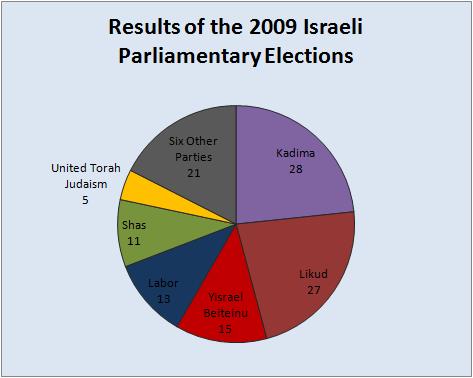
Elections for the Knesset, Israel's Parliament, were held on February 10. The elections were contentious. Both Tzipi Livni, of the centrist Kadima Party, and Benjamin Netanyahu, of the more conservative Likud Party, claimed victory on election night. It was not known which party won more seats until February 12. Kadima led by one:

However, the 28 seats won by Kadima was well short of the 61 needed for an outright parliamentary majority. A coalition was needed, and both Livni and Netanyahu could make arguments for the premiership. Livni's Kadima had won a plurality, but conservative parties won 65 seats, and Netanyahu was well-placed to form a coalition.

The ultra-right Yisrael Beiteinu placed third, and its head, Avigdor Lieberman, was proclaimed the kingmaker. Lieberman, however, is a controversial figure. He advocates a loyalty test for Arab Israelis and maintains that "the peace process is based on...false...assumptions." But achieving the premiership without his support would be either difficult or impossible.

Seeing the writing on the wall, Ehud Barak led the fourth-place, left-wing Labor Party into the Netanyahu coalition. Said Joe Klein, "The decision removes the last wisps of credibility that the Labor Party--the party of Ben Gurion, Dayan, Meir and Rabin--had in Israeli politics." Barak became defense minister; Lieberman, foreign minister.

Odds & Ends

Joe Klein says Netanyahu "is mostly blowing smoke" in his interview with Jeffrey Goldberg on Iran.

Lieberman is being investigated for "bribery, money laundering and breach of trust," upholding a longstanding tradition among Israeli politicians. After all, accusations of corruption led former PM Ehud Olmert to step down last September, which led Livni to take the reins of Kadima and the former coalition to fall apart, requiring the election in February.


Saturday, January 10, 2009

The Conflict in Gaza

"We have to talk to the other side, we have to have peace, so that we can all - us and them - live safely."     ~Mirvat Abu Shwab, who lost two children in early 2008 as Israelis and Palestinians battled outside their home

Background

On June 19, 2008, a six-month cease-fire between Hamas and Israel went into effect. The cease-fire was never absolute; during the six months, rockets were fired from Gaza into Israel, and Israel conducted raids against Hamas and closed the border crossings into Gaza. But violence had decreased. 329 rockets and mortars were fired during the cease-fire, while 2278 were fired in the preceding six months.

Hamas decided not to renew the cease-fire after it expired on December 19. Fifty rockets were launched on December 21, followed by sixty more on Christmas Eve. The same day, the Israel Defense Forces (IDF) were authorized to attack Hamas in Gaza. Although at that time, "[m]ilitary sources said a major operation - such as conquering the Gaza Strip - was not currently on the agenda."

Operation Cast Lead

On December 27, the IDF began Operation Cast Lead, a series of air strikes on Hamas targets in the Gaza Strip. 225 were killed on the first day alone. On the 28th, the IDF began targeting tunnels that ran between Egypt and Gaza, which transported arms (and needed supplies due to the Israeli-imposed blockade) into Gaza. Civilians died from the beginning, and the IDF bombed a mosque, a refugee camp, the Islamic University at Tel al-Hawa, and the Education Ministry. (In the IDF's defense, the Islamic University is "one of the prime means for Hamas to convert Palestinians to its Islamist cause.")

Throughout the air strikes, Hamas continued to fire rockets, landing deeper into Israel than ever before. Rockets landed in Beersheba, 24 miles inside Israel, two days in a row. Anger in the Arab world rose not only against Israel, but also against Egypt, which had originally brokered the six-month truce and is not allowing refugees to escape from Gaza into Egypt. Hamas gunmen and Egyptian border guards have even exchanged gunfire. And the IDF massed troops along the Gazan border.

The Invasion

On January 3, Israeli troops entered the Gaza Strip. And whatever international support Israel had evaporated. There are those who turned against Israel for reasons of realpolitik. Says Joe Klein, who was initially very supportive of Israel's actions:

The more I think about it, the ground assault has the potential to be a...big mistake. It has made a symbolic defeat more possible, if still unlikely. If the IDF gets hung up in alley-fighting in Gaza City, with significant casualties--that will be seen as a defeat. If Hamas guerrilllas can kidnap or use suicide bombers to attack the IDF positions outside Gaza, that will also be seen as an indication of Israeli vulnerability. The problem is that the expectations for Hamas--which already has had its military capability smashed decisively, if truth be told--are so low.

And the New York Times divines that Israel's goal is to remove Hamas from power and is highly skeptical. What would be the human cost? Who would fill the power vacuum left behind? Neither Fatah, a more moderate Palestinian organization nominally in control of the West Bank, nor Israel could legitimately do so.

And then of course there is the moral outrage. Israel air-dropped leaflets that read:

Hamas is getting a taste of the power of the Israeli military after more than a week and we have other methods that are still harsher to deal with Hamas. They will prove very painful. For your safety, please evacuate your neighborhood.

Unfortunately, as many neighborhoods received the same message, residents had nowhere to go.

More evidence that Israel has acted terribly:

  • A Norwegian doctor working in Gaza City reports women and children made up 25% of the death toll and 45% of the wounded.
  • Ambulances and hospitals are being attacked, and on-duty paramedics are being killed. Hospitals in Gaza lack the most basic supplies.
  • Israel is giving Gaza what they term "humanitarian respites," irregularly scheduled, three-hour suspensions in fighting every other day. (The same article reports that over 700 Palestinians, including 219 children, have been killed in the first eleven days of the assault.)
  • A UN-run school was struck by Israeli artillery, killing 40 and wounding 55 more.
  • The Vatican's peace and justice minister, Cardinal Renato Martino, said that Israel had turned the Gaza Strip into "a big concentration camp."
  • The UN and the Red Cross had to scale back aid after their trucks were hit by Israeli fire.

The Future

As the Israeli assault seemed more reprehensible, international calls for a cease-fire, led by Egypt and France, increased. Israel wants an end to the rocket attacks and arms smuggling into Gaza. Hamas wants an end to the Israeli-imposed economic blockade. Israel has accepted this in principle, but "there is a potentially long gap between accepting principles and applying practice."

The UN Security Council is meanwhile torn between two extremes. Arab countries want a resolution calling for an immediate cease-fire, while the US, Britain, and France (all permanent, veto-wielding Council members) "are pushing for a weaker statement welcoming the Franco-Egyptian initiative."

On Thursday, January 8, three rockets were fired from Lebanon into northern Israel. Hezbollah has maintained that they were not responsible for the attack and warned Israel not to use it as a pretext for opening a second front. So far it appears to me that Israel will not do so. And they should not do so. The Gaza offensive is terrible enough, and the last time Israel attacked Lebanon (in 2006), it did much to solidify Hezbollah's position there.

Jeffrey Goldberg shares a smart idea for Israel: "Why not erect a massive tent hospital in Sderot, staff it with Israeli army doctors, and treat the Palestinian wounded there?" It would be great morally and politically, so it's probably not going to happen.

For more: The BBC, per usual, has excellent reporting of the conflict. Particularly helpful is their timeline of the assault, which can be found here.


Wednesday, January 7, 2009

Oh John McCain, Look What You've Done!

God save the Middle East. When John McCain unleashed "Joe the Plumber" in the midst of the presidential debates, who would have thought that months later, "Joe" (who is not a licensed plumber and whose first name is actually Samuel) would have opinions that matter.

Apparently, conservative blog pjtv.com thinks "Joe" has a few more things for the world to hear. So, in their infinite wisdom, "Joe" is heading over to Israel to cover the current conflict in Gaza as a war correspondent in the Middle East for the blog.

Samuel J. Wurzelbacher (WUR'-zuhl-bah-kur) says he'll spend 10 days covering the fighting.

He tells WNWO-TV in Toledo that he wants to let Israel's "'Average Joes' share their story."

Wurzelbacher gained attention during the final weeks of the campaign when he asked Barack Obama about his tax plan.

He later joined Republican John McCain on the campaign trail. At one stop, he agreed with a McCain supporter who asked if he believed a vote for Obama was a vote for the death of Israel.

For more information, please click here.

Wednesday, September 24, 2008

Ahmadinejad on Larry King

This is the interview between Larry King and Iranian president Mahmoud Ahmadinejad.


He may be the Iranian version of George Bush, however, he makes some valid points amid the rest. One example of this is the double standard of the US calling on the IAEA to do more investigations on Iran than in the history of the organization rather than allowing themselves to be monitored. While Ahmadinejad may not be the best at promoting positive relations between Iran and Israel to say the least, he makes a point that the US avoids which is the plight of the Palestinean people.

While there are some valid points made, Ahmadinejad doesn't disappoint American audiences. His comments regarding Iran's own human rights issues and homosexuality are still as concerning as ever.

So, what's the answer?

Diplomacy. Diplomacy. Diplomacy.

Sunday, September 7, 2008

Beleageured Prime Minister Omnibus

Let's stop talking about what a particularly putrescent pick Palin (I like alliteration) was for a moment and discuss other (foreign) political leaders in trouble.

First up, Canada: Prime Minister Stephen Harper formally scheduled a parliamentary election for October 14, despite previously specifying a much later date (by about a year) and promising to end this sort of political manipulation. Harper is hoping to build a larger Conservative bloc in Parliament by capitalizing on his own popularity before opposition to the Canadians' commitment in Iraq and discontent with a sluggish economy grow.

Next, Israel: PM Ehud Olmert is scheduled to resign this month, as mentioned before. And now the Israeli police have formally recommended that Olmert be indicted for bribe-taking, breach of trust, and fraud. However, the recommendation has no real meaning, and it's up to AG Menachem Mazuz to actually file charges.

And no beleaguered prime minister omnibus would be complete without Thai PM Samak Sundaravej. Anti-government protesters have been camping on the grounds of Government House, the PM's residence, demanding Samak's resignation. Violence between the protesters and Samak's supporters flared five days ago, prompting Samak to declare a state of emergency and empowering the army to restore order in Bangkok. Then on Friday, in a move to defuse the situation, Samak announced that a referendum on whether Parliament should be dissolved would be held within the month, all the while steadfastly refusing to resign. Detractors are not impressed, saying a simple up-down vote cannot cover such a complex situation.

Okay, you may continue with our election now:


Monday, August 25, 2008

Human Exoskeleton Helps Paralyzed People Walk

This is an interesting article showing ReWalk's ability to help paraplegics walk again.

Here is the article below, courtesy of Reuters:

Human exoskeleton suit helps paralyzed people walk

By Ari Rabinovitch
HAIFA, Israel (Reuters) - paralyzed for the past 20 years, former Israeli paratrooper Radi Kaiof now walks down the street with a dim mechanical hum.
That is the sound of an electronic exoskeleton moving the 41-year-old's legs and propelling him forward -- with a proud expression on his face -- as passersby stare in surprise.
I never dreamed I would walk again. After I was wounded, I forgot what it's like," said Kaiof, who was injured while serving in the Israeli military in 1988.
Only when standing up can I feel how tall I really am and speak to people eye to eye, not from below."
The device, called ReWalk, is the brainchild of engineer Amit Goffer, founder of Argo Medical Technologies, a small Israeli high-tech company.
Something of a mix between the exoskeleton of a crustacean and the suit worn by comic hero Iron Man, ReWalk helps paraplegics -- people paralyzed below the waist -- to stand, walk and climb stairs.
Goffer himself was paralyzed in an accident in 1997 but he cannot use his own invention because he does not have full function of his arms.
The system, which requires crutches to help with balance, consists of motorized leg supports, body sensors and a back pack containing a computerized control box and rechargeable batteries.
The user picks a setting with a remote control wrist band -- stand, sit, walk, descend or climb -- and then leans forward, activating the body sensors and setting the robotic legs in motion.
It raises people out of their wheelchair and lets them stand up straight," Goffer said. "It's not just about health, it's also about dignity.
Kate Parkin, director of physical and occupational therapy at NYU Medical Centre, said it has the potential to improve a user's health in two ways.
Physically, the body works differently when upright. You can challenge different muscles and allow full expansion of the lungs," Parkin said. "Psychologically, it lets people live at the upright level and make eye contact."
Iuly Treger, deputy director of Israel's Loewenstein Rehabilitation Centre, said: "It may be a burdensome device, but it will be very helpful and important for those who choose to use it."
The product, slated for commercial sale in 2010, will cost as much as the more sophisticated wheelchairs on the market, which sell for about $20,000, the company said.
The ReWalk is now in clinical trials in Tel Aviv's Sheba Medical Centre and Goffer said it will soon be used in trials at the Moss Rehabilitation Research Institute in Pennsylvania.
Competing technologies use electrical stimulation to restore function to injured muscle, but Argo's Chief Operating Officer Oren Tamari said they will not offer practical alternatives to wheelchairs in the foreseeable future.
Other "robot suits," like those being developed by the U.S. military or the HAL robot of Japan's University of Tsukuba, are not suitable for paralyzed people, he said.

Friday, August 8, 2008

Headlines: 8 August 2008


Thursday, July 31, 2008

Headlines: 31 July 2008

*Note: The New York Times may be changing their website, and you may have to register/login to see these articles.

Sunday, July 20, 2008

Bomb Iran: Israeli Remix

"ISRAEL will almost surely attack Iran’s nuclear sites in the next four to seven months — and the leaders in Washington and even Tehran should hope that the attack will be successful enough to cause at least a significant delay in the Iranian production schedule, if not complete destruction, of that country’s nuclear program. Because if the attack fails, the Middle East will almost certainly face a nuclear war — either through a subsequent pre-emptive Israeli nuclear strike or a nuclear exchange shortly after Iran gets the bomb." ~Benny Morris

The insanity over Iran continues. The argument over war makes at least two leaps of logic that Joe Klein brilliantly points out here: (1) that Iran would use a nuke against Israel immediately after acquiring one and (2) that diplomacy will not work. Their basic underlying assumption is that the leaders of Iran are batshit insane. True, President Ahmadenijad may say some crazy things, but the real power lies with Supreme Leader Ali Khamenei. So let's assume that he's somewhat rational:

(1) Iran has several good reasons not to nuke Israel. Fallout from a detonation within Israel would likely contaminate parts of surrounding Muslim nations--Lebanon, Syria, Jordan, the Palestinian territories--and millions of fellow Muslims would be affected. A nuclear strike would destroy or contaminate the al-Aqsa Mosque in Jerusalem, the third-holiest Islamic site.

(2) Diplomacy and economic sanctions do have an effect against Iran according to the National Intelligence Estimate released last November.

War with Iran, conducted either by Israel or by the U.S., is not the answer. Innocent Iranians would die in an attack; one of the enrichment sites is in the middle of a city of more than one million. A pre-emptive strike would inflame Iranian public opinion against the striker, and bolster Iran's hardline regime. There's no way either nation could be sure that they've destroyed all of Iran's uranium-enrichment sites. Iran will accelerate their nuclear program, and would now have a good reason to use a nuclear weapon when they get one.

Monday, June 23, 2008

Headlines: 23 June 2008

Wednesday, May 28, 2008

Bajoobahead No. 2: Rachael Ray and Fox News

Okay, so while this may be trivial (Yahoo! always tells me trivial things when I get online; it's what they do best), I thought that this would qualify to make Rachael Ray and Fox News Bajoobaheads No. 2. Here's the story:
Rachael Ray's scarf sends blogosphere nuts

Buzz of the day: A Dunkin' Donuts ad featuring Rachael Ray wearing a scarf that looks like a keffiyeh, a traditional headdress worn by Arab men, has been yanked. "The keffiyeh has come to symbolize murderous Palestinian jihad," said conservative Fox News commentator Michelle Malkin, fueling the controversy.

Dunkin' says in a statement that the scarf was "selected by (Ray's) stylist for the advertising shoot. Absolutely no symbolism was intended. However, given the possibility of misperception, we are no longer using the commercial."

The View gals raced to Ray's defense today in a long opening chat:
Joy: "Companies should have a little more integrity."
Whoopi, who was most outraged: "It flags Rachael to businesses ... as someone you might not be able to trust."
Elisabeth: "This is the best advertising they could get.
1) We all know that Rachael Ray is stupid anyway. As for Whoopi Golberg, she went downhill fast and is looking for some attention.
2) Aside from the fact that the Israeli government's part of the whole Palestinian-Israeli Conflict part is bloodier anyway (how would you feel if someone just up and kicked you off your home and then bulldozed your house and killed your relatives and then imprisoned you and whoever else was left? Probably not too happy), the keffiyeh while often associated with Palestinian groups is not limited to them (although it has become closely associated by Westerners, often ignorant of the Middle East, to Palestinian independence).
3) A jihad is not supposed to be violent. It's simply a personal quest. For example, a student might be on a jihad to do very well in school. That's all it is. You can chill out now, Westerners.
4) Rachael Ray's stylist claims that the keffiyeh was picked for the outfit. There was an article a while back about how Westerners are now using the keffiyeh in fashion without understanding its meaning and thus upsetting people because they have trivialized what it means for Arabs, especially Palestinian groups. So basically, Westerners stop ignoring important issues that need to be resolved peacefully by trivializing them (aka totally NOT helping) and Rachael Ray, get a brain. GaaAH.
5) Fox News....'nuff said (see part 2 about the Israeli government being the by far more aggressive side).
6) Here's what Stephen Colbert has to say about this:


7) J-Mad just added to the blogosphere craze. BAM!

Sunday, May 18, 2008

In Case You Missed It

The last few days have seen George W. Bush's outrageous comments comparing Obama's willingness to engage in diplomacy with appeasing Hitler (while Bush was on a trip to Israel to mark the country's 60th anniversary, no less)...


...and the fracas between Obama and McCain that ensued.

Monday, May 5, 2008

Bomb, Bomb, Bomb...Bomb, Bomb Iran.

Political figures love to threaten to go to war with Iran. Most recently, former U.S. ambassador to the U.N. John Bolton was on Fox News arguing that attacking Iran would be "the most prudent thing to do."

In the run-up to the Pennsylvania primary, Hillary Clinton said that following an Iranian nuclear attack on Israel, her administration would "obliterate" Iran in a "massive retaliation":

(Barack Obama is hammering Clinton about her statements not only on Iran, but on her gas-tax holiday political pandering. The Iranian president lodged a formal complaint with the U.N. because of Clinton's comments.)

But nobody can mess with the original:

Obama is right. Saber-rattling only emboldens hardliners by lending credence to their claims that we are seeking to destroy Islam. The way we ensure that extremists stay out of power is by communicating and working with moderates.

Thursday, April 24, 2008

Israel + Syria: It's Complicated

Yesterday: Almost wonderful news that Israeli PM Ehud Olmert was signaling that he was ready to negotiate with Syria. Going through the Turkish PM, Recep Tayyip Erdogan, Olmert told the Syrian government that he was willing to return the Golan Heights in exchange for a lasting peace. However, returning Golan is unpopular in Israel and members of the Knesset, the Israeli Parliament, are working on a bill that would make withdrawal dependent on a nationwide referendum.

Today: The White House released a statement revealing that the target of Israel's September air strike was a Syrian nuclear reactor that "was not intended for peaceful purposes." Better yet, the technology seems to have come from North Korea. Don't worry, we're not going to war with Syria or North Korea. Although it's unclear how this will affect the six-party talks with N. Korea, the U.S. is working with/through the International Atomic Energy Agency to deal with Syria, which has some 'splainin to do about why the didn't inform the IAEA they were developing a reactor, as required by the nuclear non-proliferation treaty they signed.