
Showing posts with label Gaza. Show all posts

Friday, April 17, 2009

Israel Update

[Programming note: There are a fair few topics that I have wanted to cover but have been unable to. Hopefully, as the semester winds down, I'll be able to get to them. So if it seems slightly anachronistic that I'm talking about Israel, it's because it's the oldest project.]

Last time we talked about Israel, they were bombing Gaza. A lot has happened since then.

Details of the War Come Out

"If you want to know whether I think that in doing so we killed innocents, the answer is, unequivocally, yes." ~Tzvika Fogel, a brigadier-general in the Israeli reserves

Testimonies from Israeli soldiers were published in Ha'aretz in March. The soldiers were given the impression that Palestinian lives were "very, very, less important than the lives of our soldiers." A commander told them "to write 'death to the Arabs' on the walls...just because you can." Then, there's this story:

There was a house with a family inside ... We put them in a room ... a few days after there was an order to release [them]. There was a sniper position on the roof. The platoon commander let the family go and told them to go to the right. One mother and her two children didn't understand and went to the left, but they forgot to tell the sharpshooter on the roof they had let them go and it was OK, and he should hold his fire and he ... he did what he was supposed to, like he was following his orders.

The sharpshooter saw a woman and children approaching him, closer than the lines he was told no one should pass. He shot them ... In any case, what happened is that in the end he killed them.

International Responses

Human Rights Watch and Amnesty International condemned Israel's use of white phosphorus (pictured above) in densely populated areas. White phosphorus is often used as a smokescreen, but can also be used as an incendiary. It is particularly lethal because, in addition to being burned, the body absorbs the phosphorus, leading to organ failure.

Based on these accounts (and another where a Palestinian boy was used as a human shield), the United Nations concluded that Israel committed war crimes and violated human rights. The Israelis accused the UN Human Rights Council of bias.

The Human Rights Council recently named Judge Richard Goldstone to head an investigation into the conflict. Judge Goldstone is of Jewish descent and was an important architect of post-apartheid South Africa. According to an anonymous government official, Israel will not cooperate with the inquiry.

Parliamentary Elections

Elections for the Knesset, Israel's Parliament, were held on February 10. The elections were contentious. Both Tzipi Livni, of the centrist Kadima Party, and Benjamin Netanyahu, of the more conservative Likud Party, claimed victory on election night. It was not known which party won more seats until February 12. Kadima led by one:
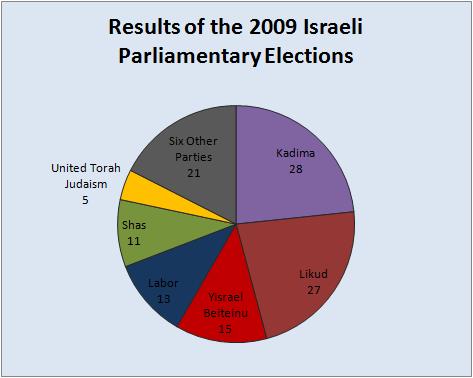
However, the 28 seats won by Kadima was well short of the 61 needed for an outright parliamentary majority. A coalition was needed, and both Livni and Netanyahu could make arguments for the premiership. Livni's Kadima had won a plurality, but conservative parties won 65 seats, and Netanyahu was well-placed to form a coalition.

The ultra-right Yisrael Beiteinu placed third, and its head, Avigdor Lieberman, was proclaimed the kingmaker. Lieberman, however, is a controversial figure. He advocates a loyalty test for Arab Israelis and maintains that "the peace process is based on...false...assumptions." But achieving the premiership without his support would be either difficult or impossible.

Seeing the writing on the wall, Ehud Barak led the fourth-place, left-wing Labor Party into the Netanyahu coalition. Said Joe Klein, "The decision removes the last wisps of credibility that the Labor Party--the party of Ben Gurion, Dayan, Meir and Rabin--had in Israeli politics." Barak became defense minister; Lieberman, foreign minister.

Odds & Ends

Joe Klein says Netanyahu "is mostly blowing smoke" in his interview with Jeffrey Goldberg on Iran.

Lieberman is being investigated for "bribery, money laundering and breach of trust," upholding a longstanding tradition among Israeli politicians. After all, accusations of corruption led former PM Ehud Olmert to step down last September, which led Livni to take the reins of Kadima and the former coalition to fall apart, requiring the election in February.



Saturday, January 10, 2009

The Conflict in Gaza

"We have to talk to the other side, we have to have peace, so that we can all - us and them - live safely."     ~Mirvat Abu Shwab, who lost two children in early 2008 as Israelis and Palestinians battled outside their home

Background

On June 19, 2008, a six-month cease-fire between Hamas and Israel went into effect. The cease-fire was never absolute; during the six months, rockets were fired from Gaza into Israel, and Israel conducted raids against Hamas and closed the border crossings into Gaza. But violence had decreased. 329 rockets and mortars were fired during the cease-fire, while 2278 were fired in the preceding six months.

Hamas decided not to renew the cease-fire after it expired on December 19. Fifty rockets were launched on December 21, followed by sixty more on Christmas Eve. The same day, the Israel Defense Forces (IDF) were authorized to attack Hamas in Gaza. Although at that time, "[m]ilitary sources said a major operation - such as conquering the Gaza Strip - was not currently on the agenda."

Operation Cast Lead

On December 27, the IDF began Operation Cast Lead, a series of air strikes on Hamas targets in the Gaza Strip. 225 were killed on the first day alone. On the 28th, the IDF began targeting tunnels that ran between Egypt and Gaza, which transported arms (and needed supplies due to the Israeli-imposed blockade) into Gaza. Civilians died from the beginning, and the IDF bombed a mosque, a refugee camp, the Islamic University at Tel al-Hawa, and the Education Ministry. (In the IDF's defense, the Islamic University is "one of the prime means for Hamas to convert Palestinians to its Islamist cause.")

Throughout the air strikes, Hamas continued to fire rockets, landing deeper into Israel than ever before. Rockets landed in Beersheba, 24 miles inside Israel, two days in a row. Anger in the Arab world rose not only against Israel, but also against Egypt, which had originally brokered the six-month truce and is not allowing refugees to escape from Gaza into Egypt. Hamas gunmen and Egyptian border guards have even exchanged gunfire. And the IDF massed troops along the Gazan border.

The Invasion

On January 3, Israeli troops entered the Gaza Strip. And whatever international support Israel had evaporated. There are those who turned against Israel for reasons of realpolitik. Says Joe Klein, who was initially very supportive of Israel's actions:

The more I think about it, the ground assault has the potential to be a...big mistake. It has made a symbolic defeat more possible, if still unlikely. If the IDF gets hung up in alley-fighting in Gaza City, with significant casualties--that will be seen as a defeat. If Hamas guerrilllas can kidnap or use suicide bombers to attack the IDF positions outside Gaza, that will also be seen as an indication of Israeli vulnerability. The problem is that the expectations for Hamas--which already has had its military capability smashed decisively, if truth be told--are so low.

And the New York Times divines that Israel's goal is to remove Hamas from power and is highly skeptical. What would be the human cost? Who would fill the power vacuum left behind? Neither Fatah, a more moderate Palestinian organization nominally in control of the West Bank, nor Israel could legitimately do so.

And then of course there is the moral outrage. Israel air-dropped leaflets that read:

Hamas is getting a taste of the power of the Israeli military after more than a week and we have other methods that are still harsher to deal with Hamas. They will prove very painful. For your safety, please evacuate your neighborhood.

Unfortunately, as many neighborhoods received the same message, residents had nowhere to go.

More evidence that Israel has acted terribly:

  • A Norwegian doctor working in Gaza City reports women and children made up 25% of the death toll and 45% of the wounded.
  • Ambulances and hospitals are being attacked, and on-duty paramedics are being killed. Hospitals in Gaza lack the most basic supplies.
  • Israel is giving Gaza what they term "humanitarian respites," irregularly scheduled, three-hour suspensions in fighting every other day. (The same article reports that over 700 Palestinians, including 219 children, have been killed in the first eleven days of the assault.)
  • A UN-run school was struck by Israeli artillery, killing 40 and wounding 55 more.
  • The Vatican's peace and justice minister, Cardinal Renato Martino, said that Israel had turned the Gaza Strip into "a big concentration camp."
  • The UN and the Red Cross had to scale back aid after their trucks were hit by Israeli fire.

The Future

As the Israeli assault seemed more reprehensible, international calls for a cease-fire, led by Egypt and France, increased. Israel wants an end to the rocket attacks and arms smuggling into Gaza. Hamas wants an end to the Israeli-imposed economic blockade. Israel has accepted this in principle, but "there is a potentially long gap between accepting principles and applying practice."

The UN Security Council is meanwhile torn between two extremes. Arab countries want a resolution calling for an immediate cease-fire, while the US, Britain, and France (all permanent, veto-wielding Council members) "are pushing for a weaker statement welcoming the Franco-Egyptian initiative."

On Thursday, January 8, three rockets were fired from Lebanon into northern Israel. Hezbollah has maintained that they were not responsible for the attack and warned Israel not to use it as a pretext for opening a second front. So far it appears to me that Israel will not do so. And they should not do so. The Gaza offensive is terrible enough, and the last time Israel attacked Lebanon (in 2006), it did much to solidify Hezbollah's position there.

Jeffrey Goldberg shares a smart idea for Israel: "Why not erect a massive tent hospital in Sderot, staff it with Israeli army doctors, and treat the Palestinian wounded there?" It would be great morally and politically, so it's probably not going to happen.

For more: The BBC, per usual, has excellent reporting of the conflict. Particularly helpful is their timeline of the assault, which can be found here.


Wednesday, January 7, 2009

Oh John McCain, Look What You've Done!

God save the Middle East. When John McCain unleashed "Joe the Plumber" in the midst of the presidential debates, who would have thought that months later, "Joe" (who is not a licensed plumber and whose first name is actually Samuel) would have opinions that matter.

Apparently, conservative blog pjtv.com thinks "Joe" has a few more things for the world to hear. So, in their infinite wisdom, "Joe" is heading over to Israel to cover the current conflict in Gaza as a war correspondent in the Middle East for the blog.

Samuel J. Wurzelbacher (WUR'-zuhl-bah-kur) says he'll spend 10 days covering the fighting.

He tells WNWO-TV in Toledo that he wants to let Israel's "'Average Joes' share their story."

Wurzelbacher gained attention during the final weeks of the campaign when he asked Barack Obama about his tax plan.

He later joined Republican John McCain on the campaign trail. At one stop, he agreed with a McCain supporter who asked if he believed a vote for Obama was a vote for the death of Israel.

For more information, please click here.

Friday, August 1, 2008

Headlines: 1 August 2008