Showing posts with label United Nations. Show all posts

Saturday, February 26, 2011

Libya Look-alikes

In any revolution, it's important to know with whom you are dealing. For Libya right now, this is all the more necessary as the identified involved parties increase and become more convoluted.

For rebels and protesters in Libya, figuring out who shape-shifter-dictator-name-changer Muammar Gaddafi is a real challenge. The Huffington Post and the Daily Show, however, lend some expertise that might help to decipher this Colonel (although why a crazy, fugly, oil-rich dictator chose to be a colonel over a higher rank is beyond me).The Daily Show also sheds light on Muammar and the Libyan situation in their series "Mess-of-the-whole-Potamia."

The Daily Show With Jon StewartMon - Thurs 11p / 10c
Mess O' The Whole Potamia Region - Libya Uprising
www.thedailyshow.com
Daily Show Full EpisodesPolitical Humor & Satire BlogThe Daily Show on Facebook

On the other hand, figuring out who the protesters and rebels are isn't easy for Muammar. In the past week, he has made several different guesses and statements, each more interesting than the one prior.

Here, we have "stray dog reporters:"


Now, we have kids on hallucinogenic pills, which are put into their coffee and milk. Oh, and these criminal kids get their directions from Osama Bin Laden and Al-Qaeda.


The United Nations Security Council passed sanctions unanimously on Gaddafi today. I wonder who he thinks really did that. Perhaps a bunch of cat-dog-pill-taking diplomats who are finally doing something about a brutal dictator. Keep watching Al-Jazeera for more updates on Libya and ridiculous statements by the Crazy Colonel.

Monday, July 5, 2010

Fo-Po Breakdown: Iran, USA, and a tad bit of Turkey

I am aware that this is sort of old news. However, since I have been busy lately and this is still an important on-going problem, I will write my blog post about it anyway. This began as a reaction to an op-ed in the New York Times, by Princeton doctoral candidate Elliot Hen-Tov and Princeton professor of Near Eastern Studies, Bernard Haykel. With the recent tightening of the newest sanctions on Iran this past Thursday, July 1, 2010, it is important to revisit this issue.

First, back to the op-ed from last month. In order to make any real headway on US-Iran relations, it is absolutely essential that each side really understand the other. For prominent scholars of prestigious universities, this also holds true. Which is why this article must be revisited – the Princeton people have it wrong. Their main assertion is that “Iran… stands to lose much influence as Turkey assumes a surprising new role as the modern, democratic and internationally respected nation willing to take on Israel and oppose America.” While parts of this statement are correct, the article represents a flawed understanding of Iranian politics and its relationship to the United States. Principally, it does not really matter for the United States (or Israel for that matter) what type of fiery rhetoric Iranian president Mahmoud Ahmadinejad uses – it is generally not directed at American or Israeli audiences anyway. The poll quoted by the authors, although irrelevant to their article, proves this point. The two major regional powers in the Middle East are Saudi Arabia, whose regime is a strong US ally, and Iran, whose regime clearly is not. When Ahmadinejad makes his statements in “support” of the Palestinian cause, he also does so bearing in mind that this can also play on Saudi Arabia’s weaknesses. Iran can claim to be the true supporter of Muslims in peril (despite a substantial number of Palestinians being of Christian or other backgrounds) while simultaneously making the Saudi regime appear weak to its people by alluding to its close relationship to the USA. In this manner, the Iranian regime hopes to remain dominant in the region over Saudi Arabia and the other Arab states.

Ahmadi-casual-Friday-nejad is not some “irrational, rouge leader” as realist IR theory would have us believe. The Iranian government’s support of Israel is mostly a domestic campaign to give the regime the appearance of standing up to the hegemonic rule of the United States and then Israel. Given the vastly superior military forces of both the USA and Israel, Iran would not risk attacking Israel. So, while these authors note that Turkey is seen by Palestinians as a much closer ally than Iran, it is crucial to understand that Iran’s political exploitation of this crisis is mostly for the purpose of bolstering domestic support for the regime and is targeted to domestic and Saudi, not international, audiences.

Secondly, I take issue with the Islam in Turkey being called “more liberal and enlightened.” Again, this is a fundamental mis-characterization of reality. While Saudi Arabia and Iran might be self-proclaimed Islamic states and Turkey a self-proclaimed secular state, the notion that any one regime is any more or less liberal/enlightened than the other is absurd when further examining their actual policies. In Iran, women are obligated to wear hijab at all times; in Turkey, there are laws making it illegal to wear the veil in some public places. Forcing people to appear secular is no better than forcing people to appear pious – these are merely two extreme ends of the spectrum. In a liberal Islam, it would seem that one would have the ability to choose without being compelled towards either end of such a spectrum. Furthermore, the fiercely secular and authoritarian policies enacted by the Turkish government can be just as bad as the authoritarian policies of Iran.

Returning to the sanctions and Turkey’s vote (along with Brasil), it is not really that much “against the United States” for Turkey to vote against the sanctions. The United States, while allies with Turkey, is far stronger allies with Saudi Arabia in the Middle East. Saudi Arabia, with the United States’ help, has stronger military and economic ties to the USA, and it is closer to the other Arab states in the Middle East than Turkey is. With Turkey looking to gain membership to the European Union, it is smart to keep its options open for markets in the Middle East for the EU, but if push came to shove for the United States, I would bet that it would retain Saudi Arabia as its ally over Turkey. Anyway, Iran and Saudi Arabia are focused on each other and Turkey is focused on the EU, so it really does not matter for Iran what Turkey says – although its vote was nice anyway.

As stated in the BBC article, the sanctions imposed in June were not very substantial. This would suggest that the Obama administration is just reacting initially to [uneducated] domestic pressures in Congress to appear to be doing something about the Iranian nuclear program. While it is good that these sanctions were not substantial, it is also extremely damaging to any potential for improving diplomatic relations between the United States and Iran, only serving to prove Ahmadinejad correct when he claims that the United States is really not interested in changing the status quo. Bolstering domestic support for the current Iranian regime is the last thing that the United States should be doing.

In a more recent development, Nom Chomsky acknowledges that Iran poses a serious threat of nuclear proliferation in the Middle East, despite citing sources earlier on in the article that discuss Iran’s relatively weak military capabilities; he just proposes different solutions instead of the United States “reinforcing [its] control of the vital Middle East oil-producing regions.” However, with Iran, this is not a valid argument either. Georgetown scholar Mehran Kamrava and University of Colorado professor Nader Hashemi are both of the opinion that Iran does not want to actually acquire a nuclear weapon. If Iran were to obtain the technology and actually produce a nuclear weapon, this would push Iran into a whole new realm of military prowess in which it would find itself on the bottom, easily bested several times over by the United States, Israel, etc. In other words, Iran can be a relatively strong conventional military power in the region, especially when compared to Saudi Arabia’s military on its own (aka minus USA support), but it would lose this advantage if it entered the nuclear arena and would find itself in a situation it cannot win. Thus, even the idea that Iran’s nuclear program to gain such knowledge is the most serious threat is absurd. The best solution would be to focus on finding common ground and interests within the Middle East between Iran and the United States (two really good examples here are Afghanistan and Iraq… hint, hint State Department) and go from here to rebuild diplomatic ties.

Speaking of best solutions, July 1st was not one of these. The New York Times reports that President Obama signed a law in one of the few moments of consensus in Congress during his administration that “imposes penalties on foreign entities that sell refined petroleum to Iran or assist Iran with its domestic refining capacity. It also requires that American and foreign businesses that seek contracts with the United States government certify that they do not engage in prohibited business with Iran.” As stated several times before, the solution is to OPEN not close relations with Iran. This means diplomatically and economically. As Ahmadi-I-say-crazy-things-that-people-should-not-listen-to-nejad stated on June 28 that he would like to resume nuclear negotiations with the United States in August, giving the United States yet another opportunity to resume meaningful dialogue, the Obama administration missed it again and chose to respond to domestic pressures. This is where the State Department people need to step in and fix it.

Caving into absurd, ill-informed domestic pressures from a Congress that cannot even agree if sick people should get help to be less sick is certain to make the problem worse, not better. The Obama administration needs to focus on its priorities, improve its image in the Muslim world and the Middle East by closing Guantanamo and playing a meaningful role in improving the situation between Israel and Palestinian territories, and respecting the sovereignty of Iran and its government despite the outcome of the 2009 presidential elections. It is certainly not an easy task and will take time to produce the change promised by the Obama campaign, but it will be easier to accomplish with greater understanding of the nuances of regional politics in the Middle East and when the United States takes an active stance by following through on some good faith measures and working with Iran as a regional power in Iraq and Afghanistan. Both the United States and Iran have a lot to gain from improving relations with one another and since the United States remains the global hegemonic power in this system of uni-multipolarity, it must responsibly take the first steps to initiate this process.

Monday, September 21, 2009

Oops! Ahmadinejad's Done It Again.

Iranian "president" Mahmoud Ahmadinejad is back in headlines after the recent protests contesting the legitimacy of his victory in the June 2009 presidential elections. This time, Ahmadinejad is once again touting his denial of the Holocaust. Ahmadinejad is scheduled to address the United Nations General Assembly this Wednesday and Iran, the United States, and other major powers are scheduled to begin negotiations in part addressing Iran's nuclear program. The United Nations will also be determining soon whether or not to enact stricter sanctions against Iran.

As quoted in the Associated Press, "the president's message during his U.N. visit will be 'peace and friendship for all nations, fighting suppression and interaction with all nations in the framework of justice and mutual respect," said a spokesman for Ahmadinejad's office, Mohammad Jafar Mohammadzadeh, according to IRNA.'" A little ironic given the elements of the government that supported Ahmadinejad and the crackdowns on protestors as recently as this past Friday, September 18, 2009...

In the words of Maz Jobrani:

Saturday, May 2, 2009

The Provocations of North Korea

On April 5, in a special birthday message to Mrs. Wolverine, North Korea launched a missile. The first stage of the rocket fell into the Sea of Japan; the rest flew over Honshu, Japan's main island, and crashed into the Pacific Ocean.

Japan, South Korea and the U.S. say the launch violates UN Security Council resolutions banning any ballistic missile activity from the North. China and Russia have urged caution and restraint.

The North Koreans claim that the rocket launched a satellite into orbit, which is now broadcasting patriotic songs from outer space. North Korea says they, like all other countries, have a right to use outer space for peaceful purposes, having joined the Convention on the Registration of Objects Launched into Outer Space in March. The only problem? They have not registered the satellite, a tacit admission that the launch failed.

So what to make of this?

While conservatives have fulminated--John Bolton: "The missile launch is an unambiguous win for North Korea"; Newt Gingrich "would have disabled the long-range missile before North Korea was able to launch it"--the truth is that North Korea has a long way to go before they have a viable nuclear ICBM. They must develop (1) a stronger missile or a miniaturized warhead and (2) a re-entry system. Plus, the North Koreans tend to respond to a failure by restarting from scratch. (h/t)

In response to the Security Council's eventual condemnation of the launch, North Korea vowed to restart its nuclear program, eject IAEA inspectors, and boycott six-party talks. North Korea later said they would start a uranium enrichment program, in addition to their previous plutonium program.

So why the launch and the subsequent "diplomatic hissy fit"? Perhaps to gain leverage in international talks. Having long-range missile technology and a nuclear program (even if they are, shall we say, limited), the North Koreans enter negotiations in a position of strength, and the international community would have to grant more concessions to make them give up these things.

Another theory says that North Korea is acting for domestic reasons. After having a stroke in August, Kim Jong-Il is demonstrating North Korea's nuclear and missile technology to solidify his leadership and to secure a stable transfer of power to one of his sons.

Finally, what should be done? Probably work through China at first, leading to six-party talks then bilateral negotiations with the United States.


Friday, April 17, 2009

Israel Update

[Programming note: There are a fair few topics that I have wanted to cover but have been unable to. Hopefully, as the semester winds down, I'll be able to get to them. So if it seems slightly anachronistic that I'm talking about Israel, it's because it's the oldest project.]

Last time we talked about Israel, they were bombing Gaza. A lot has happened since then.

Details of the War Come Out

"If you want to know whether I think that in doing so we killed innocents, the answer is, unequivocally, yes." ~Tzvika Fogel, a brigadier-general in the Israeli reserves

Testimonies from Israeli soldiers were published in Ha'aretz in March. The soldiers were given the impression that Palestinian lives were "very, very, less important than the lives of our soldiers." A commander told them "to write 'death to the Arabs' on the walls...just because you can." Then, there's this story:

There was a house with a family inside ... We put them in a room ... a few days after there was an order to release [them]. There was a sniper position on the roof. The platoon commander let the family go and told them to go to the right. One mother and her two children didn't understand and went to the left, but they forgot to tell the sharpshooter on the roof they had let them go and it was OK, and he should hold his fire and he ... he did what he was supposed to, like he was following his orders.

The sharpshooter saw a woman and children approaching him, closer than the lines he was told no one should pass. He shot them ... In any case, what happened is that in the end he killed them.

International Responses

Human Rights Watch and Amnesty International condemned Israel's use of white phosphorus (pictured above) in densely populated areas. White phosphorus is often used as a smokescreen, but can also be used as an incendiary. It is particularly lethal because, in addition to being burned, the body absorbs the phosphorus, leading to organ failure.

Based on these accounts (and another where a Palestinian boy was used as a human shield), the United Nations concluded that Israel committed war crimes and violated human rights. The Israelis accused the UN Human Rights Council of bias.

The Human Rights Council recently named Judge Richard Goldstone to head an investigation into the conflict. Judge Goldstone is of Jewish descent and was an important architect of post-apartheid South Africa. According to an anonymous government official, Israel will not cooperate with the inquiry.

Parliamentary Elections

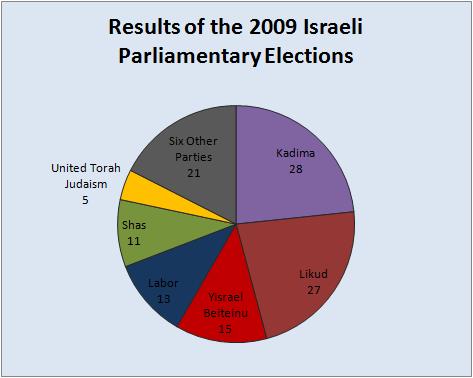
Elections for the Knesset, Israel's Parliament, were held on February 10. The elections were contentious. Both Tzipi Livni, of the centrist Kadima Party, and Benjamin Netanyahu, of the more conservative Likud Party, claimed victory on election night. It was not known which party won more seats until February 12. Kadima led by one:

However, the 28 seats won by Kadima was well short of the 61 needed for an outright parliamentary majority. A coalition was needed, and both Livni and Netanyahu could make arguments for the premiership. Livni's Kadima had won a plurality, but conservative parties won 65 seats, and Netanyahu was well-placed to form a coalition.

The ultra-right Yisrael Beiteinu placed third, and its head, Avigdor Lieberman, was proclaimed the kingmaker. Lieberman, however, is a controversial figure. He advocates a loyalty test for Arab Israelis and maintains that "the peace process is based on...false...assumptions." But achieving the premiership without his support would be either difficult or impossible.

Seeing the writing on the wall, Ehud Barak led the fourth-place, left-wing Labor Party into the Netanyahu coalition. Said Joe Klein, "The decision removes the last wisps of credibility that the Labor Party--the party of Ben Gurion, Dayan, Meir and Rabin--had in Israeli politics." Barak became defense minister; Lieberman, foreign minister.

Odds & Ends

Joe Klein says Netanyahu "is mostly blowing smoke" in his interview with Jeffrey Goldberg on Iran.

Lieberman is being investigated for "bribery, money laundering and breach of trust," upholding a longstanding tradition among Israeli politicians. After all, accusations of corruption led former PM Ehud Olmert to step down last September, which led Livni to take the reins of Kadima and the former coalition to fall apart, requiring the election in February.


Saturday, January 10, 2009

The Conflict in Gaza

"We have to talk to the other side, we have to have peace, so that we can all - us and them - live safely."     ~Mirvat Abu Shwab, who lost two children in early 2008 as Israelis and Palestinians battled outside their home

Background

On June 19, 2008, a six-month cease-fire between Hamas and Israel went into effect. The cease-fire was never absolute; during the six months, rockets were fired from Gaza into Israel, and Israel conducted raids against Hamas and closed the border crossings into Gaza. But violence had decreased. 329 rockets and mortars were fired during the cease-fire, while 2278 were fired in the preceding six months.

Hamas decided not to renew the cease-fire after it expired on December 19. Fifty rockets were launched on December 21, followed by sixty more on Christmas Eve. The same day, the Israel Defense Forces (IDF) were authorized to attack Hamas in Gaza. Although at that time, "[m]ilitary sources said a major operation - such as conquering the Gaza Strip - was not currently on the agenda."

Operation Cast Lead

On December 27, the IDF began Operation Cast Lead, a series of air strikes on Hamas targets in the Gaza Strip. 225 were killed on the first day alone. On the 28th, the IDF began targeting tunnels that ran between Egypt and Gaza, which transported arms (and needed supplies due to the Israeli-imposed blockade) into Gaza. Civilians died from the beginning, and the IDF bombed a mosque, a refugee camp, the Islamic University at Tel al-Hawa, and the Education Ministry. (In the IDF's defense, the Islamic University is "one of the prime means for Hamas to convert Palestinians to its Islamist cause.")

Throughout the air strikes, Hamas continued to fire rockets, landing deeper into Israel than ever before. Rockets landed in Beersheba, 24 miles inside Israel, two days in a row. Anger in the Arab world rose not only against Israel, but also against Egypt, which had originally brokered the six-month truce and is not allowing refugees to escape from Gaza into Egypt. Hamas gunmen and Egyptian border guards have even exchanged gunfire. And the IDF massed troops along the Gazan border.

The Invasion

On January 3, Israeli troops entered the Gaza Strip. And whatever international support Israel had evaporated. There are those who turned against Israel for reasons of realpolitik. Says Joe Klein, who was initially very supportive of Israel's actions:

The more I think about it, the ground assault has the potential to be a...big mistake. It has made a symbolic defeat more possible, if still unlikely. If the IDF gets hung up in alley-fighting in Gaza City, with significant casualties--that will be seen as a defeat. If Hamas guerrilllas can kidnap or use suicide bombers to attack the IDF positions outside Gaza, that will also be seen as an indication of Israeli vulnerability. The problem is that the expectations for Hamas--which already has had its military capability smashed decisively, if truth be told--are so low.

And the New York Times divines that Israel's goal is to remove Hamas from power and is highly skeptical. What would be the human cost? Who would fill the power vacuum left behind? Neither Fatah, a more moderate Palestinian organization nominally in control of the West Bank, nor Israel could legitimately do so.

And then of course there is the moral outrage. Israel air-dropped leaflets that read:

Hamas is getting a taste of the power of the Israeli military after more than a week and we have other methods that are still harsher to deal with Hamas. They will prove very painful. For your safety, please evacuate your neighborhood.

Unfortunately, as many neighborhoods received the same message, residents had nowhere to go.

More evidence that Israel has acted terribly:

  • A Norwegian doctor working in Gaza City reports women and children made up 25% of the death toll and 45% of the wounded.
  • Ambulances and hospitals are being attacked, and on-duty paramedics are being killed. Hospitals in Gaza lack the most basic supplies.
  • Israel is giving Gaza what they term "humanitarian respites," irregularly scheduled, three-hour suspensions in fighting every other day. (The same article reports that over 700 Palestinians, including 219 children, have been killed in the first eleven days of the assault.)
  • A UN-run school was struck by Israeli artillery, killing 40 and wounding 55 more.
  • The Vatican's peace and justice minister, Cardinal Renato Martino, said that Israel had turned the Gaza Strip into "a big concentration camp."
  • The UN and the Red Cross had to scale back aid after their trucks were hit by Israeli fire.

The Future

As the Israeli assault seemed more reprehensible, international calls for a cease-fire, led by Egypt and France, increased. Israel wants an end to the rocket attacks and arms smuggling into Gaza. Hamas wants an end to the Israeli-imposed economic blockade. Israel has accepted this in principle, but "there is a potentially long gap between accepting principles and applying practice."

The UN Security Council is meanwhile torn between two extremes. Arab countries want a resolution calling for an immediate cease-fire, while the US, Britain, and France (all permanent, veto-wielding Council members) "are pushing for a weaker statement welcoming the Franco-Egyptian initiative."

On Thursday, January 8, three rockets were fired from Lebanon into northern Israel. Hezbollah has maintained that they were not responsible for the attack and warned Israel not to use it as a pretext for opening a second front. So far it appears to me that Israel will not do so. And they should not do so. The Gaza offensive is terrible enough, and the last time Israel attacked Lebanon (in 2006), it did much to solidify Hezbollah's position there.

Jeffrey Goldberg shares a smart idea for Israel: "Why not erect a massive tent hospital in Sderot, staff it with Israeli army doctors, and treat the Palestinian wounded there?" It would be great morally and politically, so it's probably not going to happen.

For more: The BBC, per usual, has excellent reporting of the conflict. Particularly helpful is their timeline of the assault, which can be found here.

Monday, November 3, 2008

Crisis in the Congo

On Friday, the BBC reported that refugee camps in the eastern part of the Democratic Republic of the Congo had been forcibly evacuated, looted, and burned. 50,000 people were displaced by the destruction, and a million people are estimated to be have displaced by the general conflict. Lootings, murders, and rapes were reported, mostly perpetrated by Congolese troops (although both sides have their hands dirty).

Background

The area has been unstable since the Rwandan genocide in 1994. General Laurent Nkunda leads the rebel faction and has said that he is trying to protect his Tutsi community from Hutu rebels. (The Hutus killed 800,000 Tutsis and moderate Hutus in the genocide.) Nkunda is very likely receiving support from the Rwandan government under Tutsi president Paul Kagame. Rwanda has denied allegations of supporting Nkunda, but has overtly invaded DR Congo twice, including once in a five-year war that also brought in Angola, Namibia, Zimbabwe, and Uganda.

Other complicating factors are the ethnic diversity of the area, which is home to at least six ethnic groups, and its mineral wealth. The region has gold and coltan, which is used to make cell phones, and Nkunda is unhappy with a $5 billion deal between China and the Congolese government granting the Chinese access to the region.

A cease-fire in the civil war was signed in January, but the Congolese government was either unable or unwilling to prevent a third Hutu faction from using its territory, and the conflict reignited in August.

A Humanitarian Crisis

In the past ten years, five million people have died and another one million have been displaced. Food and water are scarce, and aid agencies' handouts have caused stampedes. A UN aid convoy was able to pass from Goma through Congolese and rebel lines to Rutshuru to deliver medical supplies and water purification tablets to refugees. However, many have fled into the forest, where aid cannot reach them.

Secretary General Ban ki-Moon will travel to East Africa to help resolve the crisis. Meanwhile, French Foreign Minister Bernard Kouchner has called for an increase in the size and the power of the UN peacekeeping force in the Congo. The Mission de l'Organisation des Nations Unies en RD Congo (MONUC) has 17,000 peacekeepers in the region and is the UN's largest peacekeeping mission.

What You Can Do

Donate to the UN Refugee Agency or to Oxfam, and write to your Representative and Senators.


Thursday, September 25, 2008

Ahmadinejad Speech and Press Conference

Here is Iranian president Mahmoud Ahmadinejad's speech to the General Assembly at the United Nations as well as the subsequent press conference.

United Nations address:


Press Conference:

Monday, May 5, 2008

Bomb, Bomb, Bomb...Bomb, Bomb Iran.

Political figures love to threaten to go to war with Iran. Most recently, former U.S. ambassador to the U.N. John Bolton was on Fox News arguing that attacking Iran would be "the most prudent thing to do."

In the run-up to the Pennsylvania primary, Hillary Clinton said that following an Iranian nuclear attack on Israel, her administration would "obliterate" Iran in a "massive retaliation":

(Barack Obama is hammering Clinton about her statements not only on Iran, but on her gas-tax holiday political pandering. The Iranian president lodged a formal complaint with the U.N. because of Clinton's comments.)

But nobody can mess with the original:

Obama is right. Saber-rattling only emboldens hardliners by lending credence to their claims that we are seeking to destroy Islam. The way we ensure that extremists stay out of power is by communicating and working with moderates.

Thursday, March 20, 2008

Thank You, Kofi Annan

Former U.N. Secretary-General Kofi Annan warned Thursday that military action against Iran would be "a real disaster" and said the Middle East could explode if the international community doesn't handle the many conflicts in the region very carefully...

At a wide-ranging round-table with journalists, Annan said he didn't have enough information to comment on the justification for the U.N. Security Council's demand that Iran suspend uranium enrichment until it allays suspicions its nuclear program is trying to produce weapons. Tehran insists the program is peaceful, aimed only at using nuclear power to generate electricity.

Annan said he had told Iranian leaders that "if indeed you have nothing to hide and you are not making a bomb and your intentions are pacific, open your doors, let the inspectors come, let them go anywhere — find a way of reassuring the world, not just the U.S."

Asked how the international community should deal with Iran, he said dialogue was the only way.

"We cannot, I'm sure, take on another military action in Iran, and I hope no one is contemplating it. It would be a real disaster," he said.
Finally, an important international figure speaks out against a foreign policy strategy that only promises to exacerbate conflict within a struggling region of the world. While Annan's comments might be paid more attention and heeded, he is not alone is voicing this truth; many experts share this same view and see the present problems and tensions between Iran and countries such as the United States and Britain as a direct result of grave errors in history for which these Western countries have not made amends.

Annan and other experts' point of view and recommendations for improving relations and resolving tensions have the insight that the current administration so clearly lacks. While both Iran and the United States' leaders have made inflammatory comments about one another's nations and policies but not formally communicated since 1979, dialogue, not military action, is absolutely crucial to improving relationships and healing past wounds. Through peacefully reestablishing alliances with Iran in ways that help the people of Iran, the United States will gain an ally that is key to maintaining stability, promoting real democracy, and solving conflicts throughout the region.

For the full article by the Associated Press on Kofi Annan's comments, click here
.

Friday, March 14, 2008

FREE TIBET! STOP GENOCIDE!

Monday, March 10th, 2008, marked the 49th anniversary of the failed 1959 Tibetan uprising against Chinese invasion, oppression, and genocide. While demonstration of any kind against the People's Republic of China (PRC) in the Tibetan Autonomous Region (TAR) is illegal and punishable by imprisonment, torture, and death, every year, both in the TAR and around the world (Thank You, Nepal), people bravely speak out against China's crimes. This year, the protests broke into riot in Lhasa, resulting in gunfire and intensification of the already harsh martial law.

This year however, with the upcoming Beijing 2008
Olympics, China has been under pressure to account for its human rights violations domestically as well as its involvement in support of the Khartoum government in Sudan. The Chinese government has tried to present China as a unified nation and has ignored its gross human rights abuses. On October 17, 2007, His Holiness XIV Dalai Lama was awarded the Congressional Gold Medal, the United States' highest civilian honor, by President Bush (probably the only good thing the President has and will ever do in his lifetime and although the two have met in private several times, this is the first time Bush has agreed to publicly do so). The Chinese government "called the ceremony an affront to the budding relations between the countries." While the Chinese government has attempted to paint His Holiness as a separatist, His Holiness strongly advocates for more democracy and meaningful autonomy in Tibet. The Chinese government has claimed that Tibet has always been a part of China even though all historical evidence proves otherwise.
In addition to the human rights and Geneva Convention violations that the Chinese government commits against the Tibetan people, China has implemented plans for complete ethnic/cultural genocide of the Tibetan people since China's unlawful invasion led by Mao Zedong in 1949. Some of the largest projects today that will result in this are the Quinghai-Tibet Railroad, already under construction, and the Quinghai Airport, both expected to bring in even larger numbers of Chinese into Tibet (where they currently outnumber Tibetans) and further eradicate Tibetan culture. The Chinese government states that the railroad's first run is good because "not only national pride is on the rise, but also infrastructure convenience for Sino-South Asian trade boom is largely improved" while admitting through its ambassadors that the TAR is the poorest region in China by far and contributes the least to China's economy. The Quinghai-Tibet Railroad will extend from Lhasa, the capital of the Tibet Autonomous Region (TAR), to Xigaze, near the boarders of India, Bhutan, and Nepal. The new line is expected to open in 2010 and carry seven million tons of cargo per year and eventually increase that amount to ten million tons at speeds of at least 120 km/h.

The opening of a new extension to this railroad, especially near these specific boarders, is crucial to the survival of the Tibetan people. Because of the legal system in the People’s Republic of China (PRC), Tibetans attempting to flee the TAR (most heading to Dharamsala, India) can be arrested and imprisoned. If escaping Tibetans get out of the TAR and PRC and into Nepal, they can still be arrested until they can make it to Katmandu, Nepal’s capital, and obtain official refugee status. Without those papers, they can be arrested by Nepalese officials; under King Gyanendra’s rule, Nepal and the PRC were allies so Tibetans arrested by Nepalese police were routinely handed over to PRC officials (1). However, with Maoist rebels in Nepal becoming integrated in a new political system in Nepal after a ten year war, it appears as though the PRC is unsure of what the outcome will be and if it will be able to maintain that relationship with Nepal. On February 12, 2007, a report was released by the International Campaign for Tibet documenting the passage from the TAR into exile (2). In 2006, the issue received international attention when a 25 year old Tibetan nun and other unarmed civilians were shot attempting to make a pilgrimage to HH XIV Dalai Lama. With a new railway opening near the boarders of the countries that Tibetans flee into, the PRC will be able to arrest far more Tibetans without the help of Nepalese authorities.

This situation of the railroads is reminiscent of the American railroads into the Great Plains. The expansion of rail lines into the western part of the United States led to a tremendous influx of American settlers and led to the destruction of the American Indians and their cultures. There is much evidence to suggest that the same scenario is occurring presently within the TAR. When the Qinghai-Tibet railroad first began construction, it was expected to be a major transportation route for trade and tourists, thus making Tibetans minorities in their homeland and contributing to further destruction of their culture (3). The Qinghai-Tibet Railroad was simply another way for the PRC to try to destroy a group of people and a second line opening without substantial protest from the rest of the world will have horrible repercussions for the Tibetan people and the world will witness the preventable elimination of a unique group of people and their culture.

With the Beijing 2008 Olympics around the corner, the opportunity to confront China about its genocidal policies, both domestically in Tibet and abroad in Darfur, is clear and necessary to show the commitment a country makes when signing the Geneva Conventions and joining the United Nations. As an economic tiger that may soon overtake the United States as the leading global superpower, an unwavering commitment to human rights and democracy is needed now more than ever before. While the United Nations can enforce binding economic sanctions or follow Spain's brave example of prosecuting Chinese leaders for war crimes, the international community can no longer continue to ignore the worst genocide of modern times.


(1) Sarkar, Sudeshna. Telugu Portal, 2/9/07, “Richard Gere to Launch Report on Tibetan Exodus from China.”

(2) International Campaign for Tibet, 2/8/07, “New Report Documents Dangerous Flight into Exile for Tibetans.”

(3) Yardley, Jim. New York Times, September 15, 2003, “Trying to Reshape Tibet, China Sends in the Masses”