Showing posts with label Nuclear Weapons. Show all posts

Tuesday, November 30, 2010

A Tangle in the Loom: WikiLeaks and Iran

The recent thread of WikiLeaks sheds light on a foreign policy problem of nuclear proportions.

In the past week, thousands of important documents and information have been leaked from various U.S. government agencies on WikiLeaks. The leaks are controversial, not only for their sheer number, but for release of cables and conversations between U.S. and very high-ranking officials from other countries. The leaks even prompted Barack Obama to enact new sanctions on Iran today. These sanctions blacklist 10 Iranian businesses connected to the Islamic Republic’s national bank and shipping lines, as well as five executives of these businesses.

On Monday, November 29, 2010, Iranian President Mahmoud Ahmadinejad referred to the leaked documents as “American psychological warfare that would not affect his country’s relations with other nations.” While Ahmadinejad and his administration might be crediting the U.S. bureaucracy with a bit too undeserved organizational skills by calling the leaks “organized to be released on a regular basis,” the leaked documents definitely confirm prevalent theories about the relations between Iran and its Arab gulf state neighbors and its aspirations for regional hegemony.

It is well-known that Saudi Arabia and Iran are vying for regional hegemony, with Iran’s relative conventional military power and sphere of influence giving it a strong edge over the Saudi kingdom. Not only does this allow Iran to influence the trajectories of Iraq and Afghanistan, thus extending its regional influence, its status as a regional hegemon tips the regional balance of power away from Saudi Arabia and other Arab states that have alliances with the United States. Feeling threatened by such expanding Iranian influence even in the face of decades of sanctions, it is hardly surprising that the Saudi regime harbors strong animosity for the Khamenei’s. However, it was previously unknown that the Saudi-Iranian enmity went so far that Saudi Arabian King Abdullah repeatedly begged the United States to “‘cut off the head of the snake’ by launching military strikes to destroy Iran’s nuclear program,” one of the final pieces of Iranian policy that would enable it to secure the role of an undisputed regional hegemonic power. In order to curb Iranian influence, the United States announced in October of 2010 that it will sell $60 billion worth of military aircraft to the Saudi regime.

Saudi Arabia is not the only gulf state feeling pressure to eliminate Iranian challenges to the current balance of power. King Hamad bin Isa al-Khalifa of Bahrain argued in favor of forceful action by any means necessary to eliminate the Iranian nuclear program. Bahrain, a tiny kingdom on the Persian Gulf that is home to the American Fifth Fleet’s naval base, has been feeling Iranian pressure and influence for years. In July of 2007, Iranian advisor to Khamenei Hossein Shariatmadari stated that “The public demand in Bahrain is the reunification of this province with its motherland, the Islamic Iran.” An unnamed senior Omani military official (Oman being the country that helped secure the release of American Sarah Shourd from Evin Prison), is cited in a correspondence as unable to decide which would be worse – “a strike against Iran’s nuclear capability and the resulting turmoil it would cause in the Gulf, or inaction and having to live with a nuclear-capable Iran.” In a December 2005 meeting with American military commanders, United Arab Emirates defense chief and crown prince Mohammad bin Zayed of Abu Dhabi lobbied for American military action against Iran either “this year or the next.” Bin Zayed also expressed fears of a nuclear Iranian state, declaring that “any culture that is patient and focused enough to spend years working on a single carpet is capable of waiting years and even decades to achieve even greater goals.”

While Cenk Uygur, host of The Young Turks, on MSNBC Live is not the best interviewer, the answers provided by Doctors Juan Cole and Trita Parsi in this brief interview are very informative and discuss the fears of changing regional balances of power.


Meanwhile, tensions in the region build as Israeli public opinion and Prime Minister Benjamin Netanyahu perceive a growing, intolerable Iranian nuclear threat. Ehud Barak and prominent members of the Israeli intelligence community argue that Iran is not an existential threat nor is Israel the primary target of Iranian ambitions. Even Syrian president Bashar al-Assad argues that Iran will not use a nuclear weapon against Israel, stating that “an Iranian nuclear strike against Israel would result in massive Palestinian casualties, which Iran would never risk.” However, Iranian weapons purchases from North Korea does little to convince the public and Israeli politicians writ large of this understanding. Netanyahu views the WikiLeaks as something positive for Israel, confirming his suspicions about Iranian nuclear ambitions and showing the extent to which Israel and Arab states share a strong mutual interest in preventing Iranian hegemonic aspirations.

Tensions continue to escalate between these states and power blocs in the Middle East. Yesterday, two prominent Iranian nuclear scientists, both professors at Tehran’s Shahid Beheshti University, were attacked in different parts of Tehran. Assailents on motorcycles managed to attach and detonate magnetized car bombs to the cars of scientists Majid Shahriari and Fereydoun Abbasi, the former killed and the latter injured with his wife. Shahriari was involved in a major project with Iran’s nuclear agency, and Abbasi is a member of the Islamic Revolutionary Guard Corps (IRGC) and listed as one of several involved in secret nuclear activity in a 2007 U.N. resolution. Abbasi was formerly an expert for Iran’s Defense Ministry and a top specialist in nuclear isotope separation. The Iranian regime currently blames Israel and the United States for orchestrating these attacks. Intelligence analysts blame Mossad for the 2007 death of top Esfahan uranium plant scientist Ardeshire Hassanpour. In January of 2010, Massoud Ali-Mohammadi was also killed, but it is unclear whether his death was related to his support of Mir Hossien Mousavi or an Israeli/American operation; he also died in a car bombing similar to that of Shahriari.

The WikiLeaks available thus far clearly confirm the fears of Arab gulf states and seem to perpetuate Israeli public opinion and Netanyahu’s threat perceptions of Iran. In moving forward from the latest sanctions on Iran, the United States must decide how to manage these states’ interests to balance with its own in the Middle East and avoid yet another military conflict that would have, in Barak’s words, “unacceptable collateral damage,” on all sides.

Sunday, April 11, 2010

Don't Let's START

On April 8, President Barack Obama and his Russian counterpart, Dmitry Medvedev, signed a new Strategic Arms Reduction Treaty (START) in Prague. The treaty would limit each country to 1,550 nuclear warheads, a 30% reduction from the Moscow Treaty (aka SORT).

Of course, because Barack Obama supports it, the Republicans oppose it in true knee-jerk fashion. Never mind that any substance-based opposition is not based on fact. Never mind that arms control has a long history of bipartisan support, with the Senate ratifying the Moscow Treaty 95-0. Never mind that 1,550 warheads is more than a sufficient nuclear deterrent. Never mind that reducing the number of nuclear weapons will make the U.S. safer by reducing the threat of nuclear terrorism.

No, Republicans would rather oppose ratifying the treaty, which needs 67 votes in the Senate, just so they can make Obama look bad. But haven't we come to expect this kind of petty recklessness from the GOP?

Monday, September 21, 2009

Oops! Ahmadinejad's Done It Again.

Iranian "president" Mahmoud Ahmadinejad is back in headlines after the recent protests contesting the legitimacy of his victory in the June 2009 presidential elections. This time, Ahmadinejad is once again touting his denial of the Holocaust. Ahmadinejad is scheduled to address the United Nations General Assembly this Wednesday and Iran, the United States, and other major powers are scheduled to begin negotiations in part addressing Iran's nuclear program. The United Nations will also be determining soon whether or not to enact stricter sanctions against Iran.

As quoted in the Associated Press, "the president's message during his U.N. visit will be 'peace and friendship for all nations, fighting suppression and interaction with all nations in the framework of justice and mutual respect," said a spokesman for Ahmadinejad's office, Mohammad Jafar Mohammadzadeh, according to IRNA.'" A little ironic given the elements of the government that supported Ahmadinejad and the crackdowns on protestors as recently as this past Friday, September 18, 2009...

In the words of Maz Jobrani:

Saturday, May 2, 2009

The Provocations of North Korea

On April 5, in a special birthday message to Mrs. Wolverine, North Korea launched a missile. The first stage of the rocket fell into the Sea of Japan; the rest flew over Honshu, Japan's main island, and crashed into the Pacific Ocean.

Japan, South Korea and the U.S. say the launch violates UN Security Council resolutions banning any ballistic missile activity from the North. China and Russia have urged caution and restraint.

The North Koreans claim that the rocket launched a satellite into orbit, which is now broadcasting patriotic songs from outer space. North Korea says they, like all other countries, have a right to use outer space for peaceful purposes, having joined the Convention on the Registration of Objects Launched into Outer Space in March. The only problem? They have not registered the satellite, a tacit admission that the launch failed.

So what to make of this?

While conservatives have fulminated--John Bolton: "The missile launch is an unambiguous win for North Korea"; Newt Gingrich "would have disabled the long-range missile before North Korea was able to launch it"--the truth is that North Korea has a long way to go before they have a viable nuclear ICBM. They must develop (1) a stronger missile or a miniaturized warhead and (2) a re-entry system. Plus, the North Koreans tend to respond to a failure by restarting from scratch. (h/t)

In response to the Security Council's eventual condemnation of the launch, North Korea vowed to restart its nuclear program, eject IAEA inspectors, and boycott six-party talks. North Korea later said they would start a uranium enrichment program, in addition to their previous plutonium program.

So why the launch and the subsequent "diplomatic hissy fit"? Perhaps to gain leverage in international talks. Having long-range missile technology and a nuclear program (even if they are, shall we say, limited), the North Koreans enter negotiations in a position of strength, and the international community would have to grant more concessions to make them give up these things.

Another theory says that North Korea is acting for domestic reasons. After having a stroke in August, Kim Jong-Il is demonstrating North Korea's nuclear and missile technology to solidify his leadership and to secure a stable transfer of power to one of his sons.

Finally, what should be done? Probably work through China at first, leading to six-party talks then bilateral negotiations with the United States.


Tuesday, October 7, 2008

Another Dilemma with Iran

The Associated Press reported that Iran ordered an aircraft to land due to invaded airspace and then questioned the plane's passengers. Iran then allowed the plane and its passengers to continue to their destinations.

If this behavior of negative reciprocity continues, there will be escalation and more tension between Iran and the United States, making attempts for genuine diplomacy more difficult. And genuine diplomacy is what is really needed between the United States and Iran. Also affecting the possibilities of real progress and improving relations between the two countries is each country's presidential election (2008 for the United States and 2009 for Iran). Hopefully, the leaders elected in each respective country are more serious and sincere about diplomacy and less inflammatory to one another.

Read the Associated Press article below for more information on the plane situation.

Iran says it forced down Western plane

TEHRAN, Iran - Iranian news reports claimed Tuesday that Iran forced down a Western aircraft that accidentally entered its airspace, then allowed the plane to continue to Afghanistan after questioning its passengers.

The state-owned Al-Alam, Iran's official Arabic-language television station, quoted an unidentified senior Iranian military official as saying the plane belonged either to a British or Hungarian relief agency. It said Iran forced the aircraft to land on Sunday and then permitted the passengers and crew to leave the following day.

The U.S. military in Iraq issued a statement noting "media reports that a small, civilian passenger jet was forced to land in Iran. This was not a U.S. aircraft and there were no Americans reported on board. All U.S. aircraft are accounted for and none are missing."

White House spokesman Gordon Johndroe said, "We're looking into the various and conflicting reports coming from the Iranian `news' agencies, but do not have any information at this time that would lead us to believe they are correct."

Iranian Foreign Ministry spokesman Hasan Qashqavi said he had no information about the case. Other Iranian officials could not immediately be reached for comment.

The official quoted by Al-Alam said the plane "lost its way" and violated Iranian air space. He said the passengers — who he said included American military personnel — were questioned and that the plane was allowed to continue to Afghanistan.

In Afghanistan, officials with the U.S. military, the American Embassy and the British Embassy said they had no information about a plane being forced down in Iran.

Initially, the semiofficial Fars news agency said the plane was American. Fars reported that the plane was carrying five military officials and three civilians from Turkey to Afghanistan when it "unintentionally" entered Iranian airspace.

According to the Fars report, Iranian fighters guided the plane to an Iranian airport, the passengers were questioned and a day later were released and allowed to continue to their destination.

Fars said the plane was a Falcon, apparently referring to a passenger aircraft manufactured by the French firm Dassault and primarily used by business executives. Dassault Falcon produces five jets with ranges from about 3,250 nautical to more than 4,000 nautical miles, with cabins that typically carry about six passengers and two crew members.


Wednesday, August 6, 2008

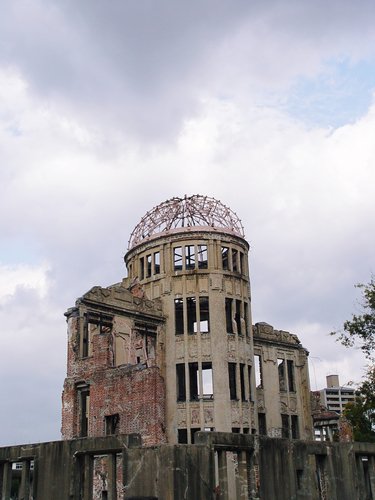
Japan Marks Anniversary of Atomic Bombings (Aug 6 & 9)


This is taken from Reuters and reposted below.
Japan Marks Anniversary of Hiroshima Atomic Bomb
TOKYO (Reuters) - Tens of thousands bowed their heads at a ceremony in the Japanese city of Hiroshima on Wednesday, the 63rd anniversary of the world's first atomic attack, as the city's mayor hit out at countries that refuse to abandon their bombs.

A bell tolled at 8:15 a.m. to mark the exact moment when the bomb dubbed "Little Boy" was dropped on the city, killing tens of thousands immediately and many more later from radiation sickness.

"We who seek the abolition of nuclear weapons are the majority," mayor Tadatoshi Akiba said in a speech at the Peace Memorial Park, attended by the ambassador of nuclear-armed China, as well as Prime Minister Yasuo Fukuda and elderly survivors of the attack.

"Last year 170 countries voted in favor of Japan's U.N. resolution calling for the abolition of nuclear weapons. Only three countries, the United States among them, opposed this resolution," he said.

The United States and other world powers fear Iran is developing nuclear weapons, while Tehran says its atomic program is for power generation. Washington and others have warned of more sanctions against Tehran, which they accuse of playing for time in the dispute.

The mayor of Hiroshima also vowed to do more to help survivors still suffering the physical and mental after-effects of the 1945 attack by the United States in the final days of World War Two, which was followed a few days later by a nuclear attack on the southern Japanese city of Nagasaki.

The average age of survivors is over 75 and Akiba said he would launch a survey into the emotional damage they suffered.

Fukuda echoed some of Akiba's sentiments, saying he wanted to take a lead in the campaign against nuclear weapons and try to help as many as possible of those dealing with poor health after being exposed to radiation.

"We must not repeat such a sad event," one mother attending the ceremony told broadcaster NHK. "We need to pass that message on to our children's generation."

(Reporting by Isabel Reynolds; Editing by Hugh Lawson)


ABOLISH NUCLEAR WEAPONS!

Sunday, July 20, 2008

Bomb Iran: Israeli Remix

"ISRAEL will almost surely attack Iran’s nuclear sites in the next four to seven months — and the leaders in Washington and even Tehran should hope that the attack will be successful enough to cause at least a significant delay in the Iranian production schedule, if not complete destruction, of that country’s nuclear program. Because if the attack fails, the Middle East will almost certainly face a nuclear war — either through a subsequent pre-emptive Israeli nuclear strike or a nuclear exchange shortly after Iran gets the bomb." ~Benny Morris

The insanity over Iran continues. The argument over war makes at least two leaps of logic that Joe Klein brilliantly points out here: (1) that Iran would use a nuke against Israel immediately after acquiring one and (2) that diplomacy will not work. Their basic underlying assumption is that the leaders of Iran are batshit insane. True, President Ahmadenijad may say some crazy things, but the real power lies with Supreme Leader Ali Khamenei. So let's assume that he's somewhat rational:

(1) Iran has several good reasons not to nuke Israel. Fallout from a detonation within Israel would likely contaminate parts of surrounding Muslim nations--Lebanon, Syria, Jordan, the Palestinian territories--and millions of fellow Muslims would be affected. A nuclear strike would destroy or contaminate the al-Aqsa Mosque in Jerusalem, the third-holiest Islamic site.

(2) Diplomacy and economic sanctions do have an effect against Iran according to the National Intelligence Estimate released last November.

War with Iran, conducted either by Israel or by the U.S., is not the answer. Innocent Iranians would die in an attack; one of the enrichment sites is in the middle of a city of more than one million. A pre-emptive strike would inflame Iranian public opinion against the striker, and bolster Iran's hardline regime. There's no way either nation could be sure that they've destroyed all of Iran's uranium-enrichment sites. Iran will accelerate their nuclear program, and would now have a good reason to use a nuclear weapon when they get one.